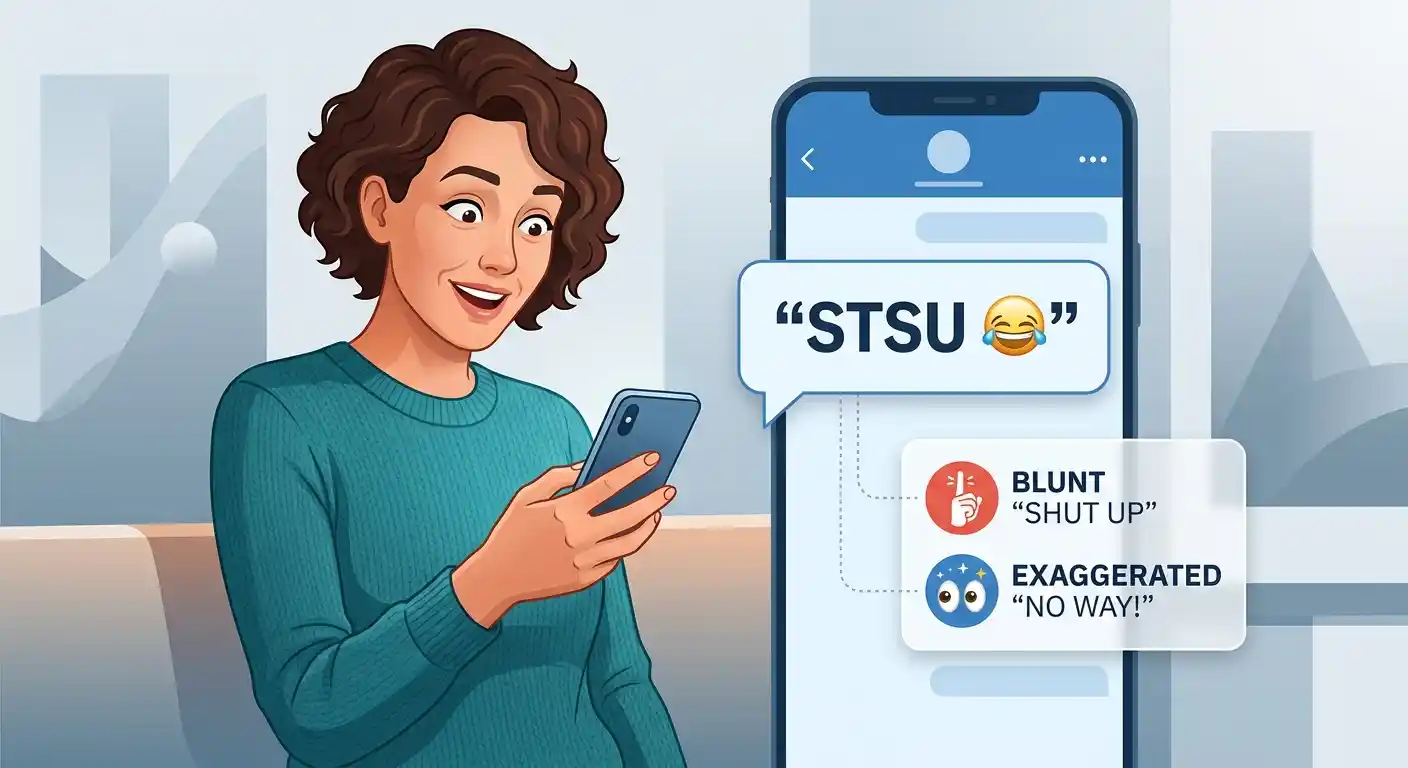
STSU usually means “Shut That Sht Up” or “Shut The Sht Up” in texting. It is an informal internet slang abbreviation that can tell someone to stop talking, but friends may also use it playfully to show surprise, disbelief, or amusement.
Key Takeaways
- STSU is an informal texting abbreviation associated with a “shut up” expression.
- It can be serious or playful, depending on the conversation.
- Friends may use STSU as a reaction meaning “No way!” or “You’re kidding!”
- It is closely related to STFU, but the wording and tone can differ.
- STSU is not appropriate for professional or formal communication.
- Context matters, especially when the message contains emojis, punctuation, or other clues.
STSU Meaning in Text
In text messages and online conversations, STSU is generally used as a blunt “shut up” expression. The exact expansion varies slightly, with both “Shut That Sht Up” and “Shut The Sht Up” appearing in slang references.
It is best understood as informal internet slang or messaging shorthand, rather than a standard English abbreviation.
Depending on context, STSU can communicate:
- “Stop talking.”
- “Be quiet.”
- “No way!”
- “You’re kidding!”
- “I can’t believe you said that!”
For example:
Friend: “I just won free concert tickets.”
Reply: “STSU 😂”
Here, STSU is likely a dramatic reaction to surprising news rather than a serious request for silence.
However, if someone writes:
“STSU. I’m trying to talk.”
the message sounds much more direct and annoyed.
Because STSU is not as standardized as abbreviations such as LOL, BRB, or IMO, context is especially important.
What Does STSU Stand For?
STSU is commonly expanded as “Shut That Sh*t Up” or “Shut The Sh*t Up.” The difference between “that” and “the” appears in different user-generated slang references, so there is not one perfectly standardized expansion.
The letters generally represent:
- S = Shut
- T = That/The
- S = Sh*t
- U = Up
The phrase is a stronger and more informal way of telling someone to stop talking. In friendly conversations, however, it can be exaggerated for humor or disbelief.
How Is STSU Used?
STSU can appear in casual digital communication when someone wants to react quickly without typing a complete sentence.
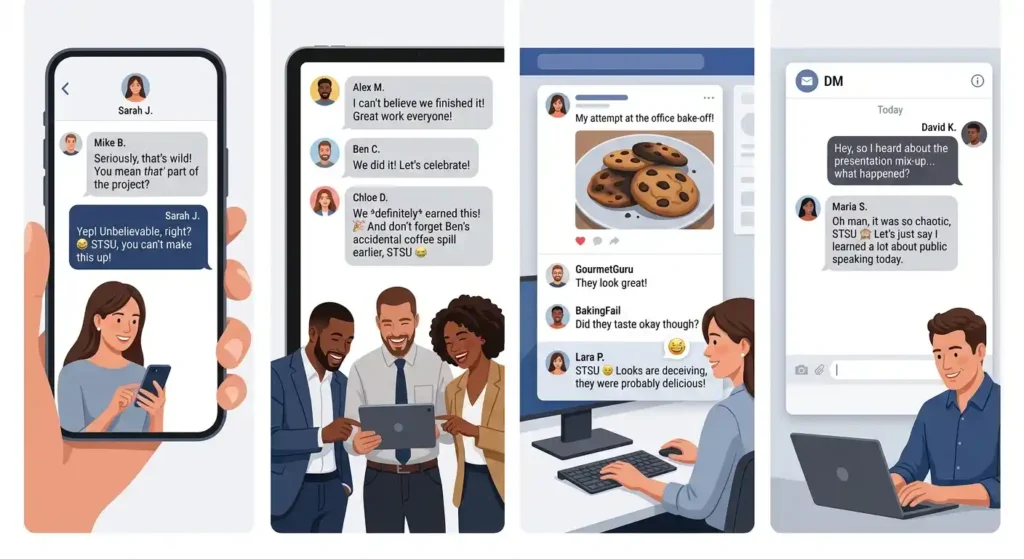
Text Messages
Friends may use STSU after hearing something surprising, funny, or unbelievable.
Example:
“STSU, you actually got tickets?!”
Group Chats
In a group chat, STSU can work as a joking reaction to someone’s story, claim, or unexpected announcement.
Example:
“STSU 😂 You did not really say that.”
Social Media Comments
Someone might use STSU as a short reaction to a surprising post or funny comment.
Example:
“STSU 😭 this cannot be real.”
The meaning still depends on the surrounding conversation rather than the platform alone.
DMs
In a private message, STSU may be used between people who already understand each other’s humor.
Example:
“STSU, tell me you’re joking.”
STSU in Different Contexts
The same four letters can feel very different depending on the relationship and conversation.
From a Friend
Between close friends, STSU may be playful teasing.
Example:
“I’m definitely the best player here.”
“STSU 😂”
From a Guy or Girl
The sender’s gender does not automatically change the meaning of STSU. A guy and a girl can use it in the same basic ways.
Look at the surrounding messages, punctuation, emojis, and relationship instead of assuming the sender has a hidden romantic meaning.
In Dating or With a Crush
STSU can sometimes appear as playful banter between people who already joke around. However, the abbreviation does not by itself prove flirting or romantic interest.
For example:
“I finally asked them out.”
“STSU 😭 You actually did it?”
That reads as excited disbelief, not necessarily a romantic message.
During an Argument
STSU can become much harsher during an argument.
Example:
“I already told you to stop interrupting me.”
“STSU.”
Here, it is more likely to be a genuine demand for someone to stop talking.
In a Group Chat
The reaction can be playful when the group is joking, but it can also sound rude if the conversation is already tense.
Real Chat Examples
Here are realistic ways STSU might appear in casual messaging:
- A: “I got front-row seats.”
B: “STSU 😭 seriously?” - A: “I finished the whole project in one night.”
B: “STSU 😂” - A: “You won’t believe who I saw today.”
B: “STSU, who?” - A: “I actually won.”
B: “STSU! No way.” - A: “He said the funniest thing.”
B: “STSU 😂 tell me everything.” - A: “I’m moving next month.”
B: “STSU, you’re joking.” - A: “Guess who texted me.”
B: “STSU 😭 who?” - A: “I accidentally sent it to the wrong person.”
B: “STSU 😂” - A: “You seriously believe that?”
B: “STSU.” - A: “I told everyone your secret.”
B: “STSU bro 😭” - A: “She actually remembered my birthday.”
B: “STSU, that’s so sweet.” - A: “I just met my favorite athlete.”
B: “STSU 😭” - A: “I’m quitting the team.”
B: “STSU. Wait, what?” - A: “That was the worst excuse I’ve ever heard.”
B: “STSU 😂” - A: “You keep making things up.”
B: “STSU already.” - A: “I got an A on the test.”
B: “STSU! Congrats though.” - A: “I ate the whole pizza.”
B: “STSU 😂” - A: “You’re telling me you never watched that movie?”
B: “STSU 😭” - A: “I finally did it.”
B: “STSU, you actually did it!” - A: “Please stop interrupting me.”
B: “STSU.”
The last example has a noticeably more serious tone because of the surrounding context.
How to Reply to STSU
Your response should match the tone of the original message.
Casual Replies
If the sender is clearly joking:
- “😂 Okay, okay.”
- “I’m just saying!”
- “Fineee.”
- “You heard me.”
- “Haha, relax.”
Friendly Replies
If it is playful between friends:
- “You know I’m right 😂”
- “I knew you’d say that.”
- “Don’t act surprised.”
- “I’m serious though!”
- “You’re too funny.”
Funny Replies
If the conversation is clearly joking:
- “Make me 😂”
- “Too late.”
- “Nope, I’m not stopping.”
- “You’ll survive.”
- “I have more to say.”
Neutral Replies
If you cannot tell whether STSU is serious:
- “What do you mean?”
- “Are you joking?”
- “Wait, seriously?”
- “Okay, I’ll stop.”
- “Did I say something wrong?”
A neutral question is often the safest choice when the tone is unclear.
Flirty/Relationship Replies
Only use a playful response if the existing conversation already has that tone:
- “You love hearing me talk 😂”
- “You know you don’t mean that.”
- “Okay, I’ll behave.”
- “Only if you ask nicely.”
STSU alone should not be treated as evidence of flirting.
What Tone Does STSU Have?
STSU is highly context-dependent.
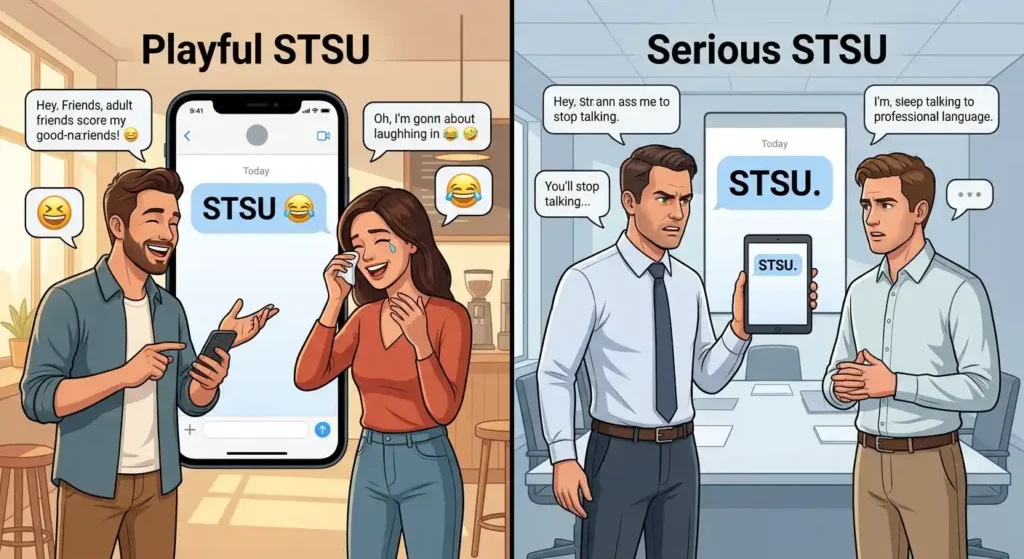
It can sound:
- Playful when used with laughing emojis or between close friends
- Surprised when reacting to unexpected news
- Teasing during friendly banter
- Sarcastic when someone makes an exaggerated claim
- Direct when telling someone to stop talking
- Annoyed or rude during an argument
Punctuation and emojis can make a major difference. “STSU 😂” can feel very different from “STSU.” The surrounding conversation matters too.
Is STSU Rude or Offensive?
STSU can be rude, because its underlying phrase contains profanity and directly tells someone to stop talking.
It may be acceptable as joking slang between friends who understand each other’s humor, but it can easily sound disrespectful when used with someone you do not know well.
Casual Conversations
It may be understood as playful among close friends, especially when the conversation is already humorous.
School
It is better to avoid STSU in school communication. A teacher, classmate, or school staff member could interpret it as disrespectful.
Work
STSU is not appropriate for professional messages, emails, or workplace communication.
Formal Writing
Avoid it in essays, applications, reports, and other formal writing. Use clear language instead.
If someone sends STSU during a serious disagreement, do not automatically assume they are joking.
Other Meanings of STSU
STSU as “Stay True, Stay You”
Some online sources also use STSU for “Stay True, Stay You,” particularly in motivational or supportive contexts. This is a different interpretation from the “shut up” slang meaning.
For example:
“Ignore the negativity and STSU.”
In a motivational message like this, the surrounding words can signal that STSU is intended as an encouraging phrase.
This meaning appears to be less directly established in slang references than the “shut up” interpretation, so context should determine whether it applies.
Common Mistakes About STSU
Assuming STSU Always Means One Thing
The “shut up” interpretation is the main slang meaning found in current references, but alternative uses exist. Context should always be checked.
Assuming It Always Means Anger
STSU can be playful or expressive rather than genuinely hostile.
Assuming It Proves Someone Is Flirting
It does not. A playful STSU can occur between friends, siblings, classmates, or people who simply joke together.
Confusing STSU With STFU
The two abbreviations have a similar basic purpose, but they are not identical. STFU uses stronger wording, while STSU is commonly used as a related variation.
Using It in Formal Communication
Even when intended as a joke, STSU can easily appear disrespectful outside casual conversations.
STSU and Related Slang
| Term | Meaning | Common Use |
|---|---|---|
| STFU | Strong “shut up” expression | Direct or heated slang |
| STHU | “Shut the hell up” | Informal request or reaction |
| LOL | Laughing/reaction to something funny | Casual texting |
| OMG | Expresses surprise or excitement | Texts and social media |
| BRB | Be right back | Messaging shorthand |
STFU and STHU are the closest comparisons because they can also express a reaction to someone’s words or tell someone to stop talking.
People Also Ask About STSU
What does STSU mean in texting?
STSU generally refers to “Shut That Sh*t Up” or “Shut The Sh*t Up.” Depending on context, it can be a serious command or a playful reaction meaning “No way!” or “You’re kidding.”
Is STSU the same as STFU?
They have a similar purpose, but they are different abbreviations. STSU is commonly associated with a variation of the “shut up” expression, while STFU uses stronger wording.
Is STSU a bad word?
STSU itself is an abbreviation, but its commonly intended phrase contains profanity. Because of that, it can sound rude or offensive, especially in formal or unfamiliar settings.
What does STSU mean from a friend?
From a friend, STSU may simply be playful teasing or disbelief. For example, “STSU 😂” after surprising news can mean something closer to “No way!” than a literal request to be quiet.
Does STSU mean flirting?
Not by itself. The abbreviation can appear in playful conversations, but STSU alone cannot establish romantic interest. The surrounding conversation and relationship provide the useful context.
Can STSU mean “Stay True, Stay You”?
Yes, some online references use STSU for “Stay True, Stay You.” If the message is motivational or encouraging rather than reactive, that interpretation may fit better.
What should I reply if someone texts STSU?
If the tone is unclear, ask what they mean or respond neutrally. If it is obviously playful, a light response such as “Okay, okay 😂” can match the conversation.
Conclusion
STSU usually refers to a casual “shut up” expression such as “Shut That Sht Up” or “Shut The Sht Up.” It can be blunt and rude, but friends may also use it playfully to show surprise, disbelief, or amusement.
The safest way to interpret STSU is to consider the conversation, relationship, punctuation, and emojis. A smaller alternative meaning is “Stay True, Stay You,” which mainly fits supportive or motivational contexts.

For three and a half years, Charlotte Reed has worked as a writer shaping puns and jokes around distinct subjects and vocabulary. She covers food, animals, seasonal themes, technology, entertainment, and trending topics. Her process includes examining topic-specific language, building wordplay from relevant terms, and editing punchlines for sharper phrasing, structure, and comedic timing.