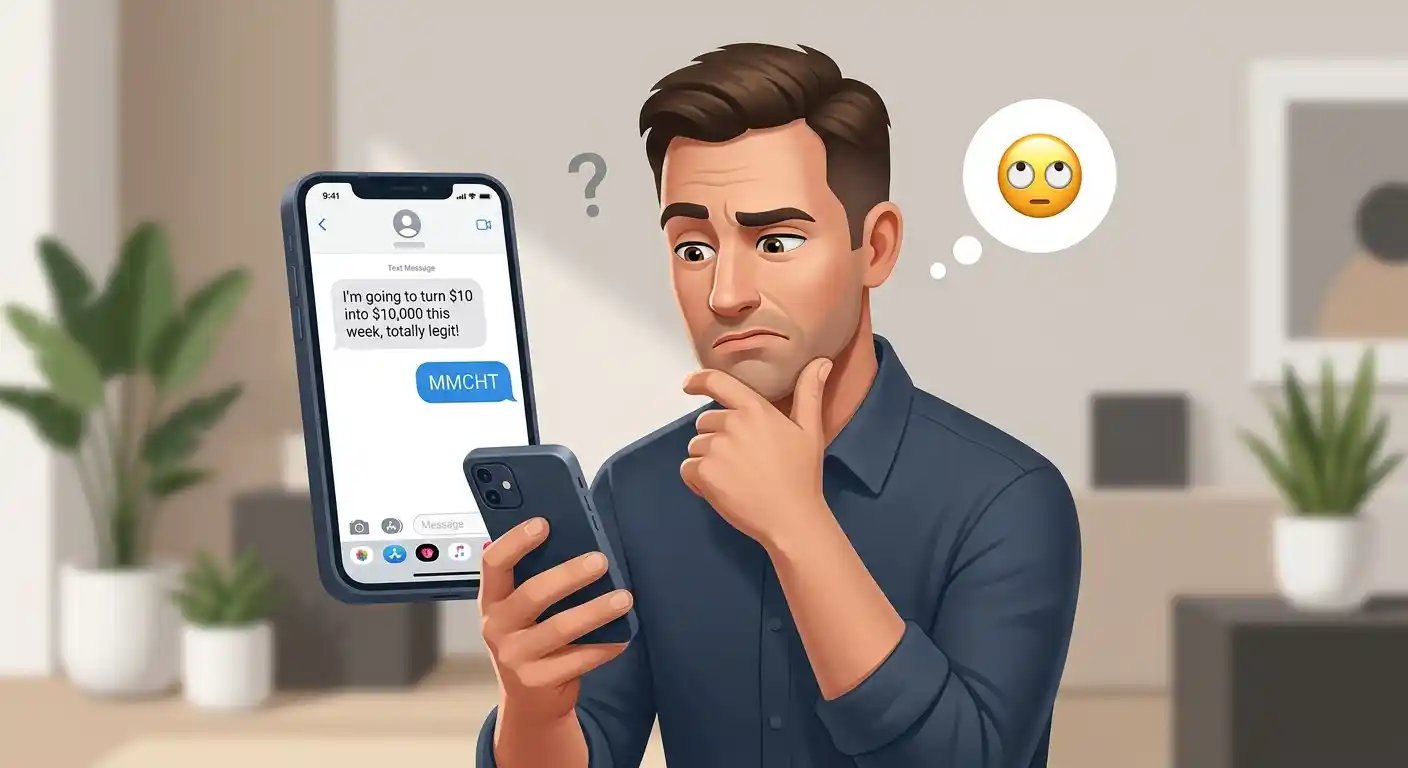
MMCHT is an informal text expression that usually represents a dismissive or expressive sound, often showing annoyance, disbelief, disapproval, or skepticism. It is not a standard acronym with one universally accepted full form.
Key Takeaways
- MMCHT is generally a sound-based texting expression, not a conventional acronym.
- It can communicate annoyance, disbelief, disapproval, skepticism, or an unimpressed reaction.
- Depending on context, it can feel similar to “tsk,” “seriously?”, “yeah, okay,” or “come on.”
- The tone can be playful, sarcastic, dismissive, or genuinely irritated.
- There is no reliable single full form that should automatically be assigned to MMCHT.
- Because it is informal and context-dependent, it is best suited to casual online conversations.
MMCHT Meaning in Text
In texting, MMCHT is usually a written representation of a reaction sound rather than a shortened sentence. It can resemble the sound someone makes when they are unimpressed, doubtful, annoyed, or reacting to something they do not agree with.
Depending on the situation, MMCHT can be understood as:
- “Seriously?”
- “Come on.”
- “Yeah, okay.”
- “I don’t believe you.”
- “That’s annoying.”
- “I’m not impressed.”
- “Really?”
- “Uh-huh…”
For example:
Friend: “I forgot my homework again.”
You: “Mmcht 😑”
Here, MMCHT communicates mild frustration or disapproval.
In another conversation:
Friend: “You think I’m going to believe that?”
Reply: “Mmcht…”
The same expression can suggest skepticism or disbelief.
This makes MMCHT different from straightforward texting abbreviations such as LOL or BRB. Its meaning comes more from the reaction and tone than from individual letters.
What Does MMCHT Stand For?
MMCHT does not have a confirmed, universally accepted full form. Current references that describe it as a texting expression generally treat it as a phonetic or sound-based reaction, rather than an acronym whose letters stand for a fixed phrase.
So, it is better to think of:
MMCHT = a written reaction sound
rather than trying to expand every letter into separate words.
Some online pages give MMCHT various supposed full forms, but conflicting definitions make those expansions unreliable. One search result, for example, claims a completely different phrase, while multiple other references describe MMCHT as a sound or reaction.
For everyday texting, the reaction-based meaning is the safer interpretation unless the sender gives you more context.
How Is MMCHT Used?
MMCHT can appear when someone wants to communicate an attitude or reaction without writing a full sentence.
Text Messages
A person may type MMCHT after hearing something frustrating or questionable.
Example:
“You canceled again? Mmcht.”
DMs
In a private conversation, it can be used as a quick emotional response.
Example:
“Mmcht, I knew you were going to say that.”
Group Chats
Friends may use it as a dramatic or humorous reaction.
Example:
“MMCHT 😂 y’all are actually serious?”
Social Media Comments
It can also work as a short reaction to something surprising, questionable, or unimpressive.
Example:
“Mmcht… that’s wild.”
The expression is informal, so the surrounding conversation usually tells you more than the letters themselves.
MMCHT in Different Contexts
Context is especially important with MMCHT because it does not have one rigid definition.
From a Friend
Between friends, MMCHT can be playful.
Example:
“Mmcht 😂 you really thought that would work?”
The sender may be teasing rather than genuinely angry.
From a Guy or Girl
The sender’s gender does not change the basic meaning of MMCHT.
If a guy or girl sends “mmcht,” look at the previous messages, punctuation, emojis, and overall conversation before deciding whether it is playful, annoyed, or dismissive.
From a Crush
MMCHT alone does not prove flirting or romantic interest.
If someone says:
“You really wore that to the party? Mmcht 😂”
it could simply be teasing. The relationship and previous conversation matter more than the slang itself.
During an Argument
MMCHT can sound more serious when the conversation is already tense.
Example:
“You keep making the same excuse. Mmcht.”
Here, it may communicate frustration or disbelief rather than playful teasing.
In Social Media Comments
When used under a post, MMCHT can signal that someone is unimpressed, skeptical, or reacting dramatically.
Real Chat Examples
Here are natural examples showing how the meaning can shift with context:
- A: “I forgot to call you back.”
B: “Mmcht 😑” - A: “He said he didn’t eat the last slice.”
B: “MMCHT, sure.” - A: “I got a perfect score.”
B: “Mmcht 😂 okay genius.” - A: “You’re seriously blaming me?”
B: “Mmcht…” - A: “I told you I was going to be late.”
B: “Mmcht, I knew it.” - A: “She canceled again.”
B: “Mmcht. Typical.” - A: “You believe that story?”
B: “MMCHT 😭 no way.” - A: “I didn’t touch your snacks.”
B: “Mmcht, then where did they go?” - A: “That movie was actually good.”
B: “Mmcht 😂 we watched the same movie.” - A: “I’m definitely winning tomorrow.”
B: “Mmcht, we’ll see.” - A: “I forgot the test was today.”
B: “Mmcht 😭” - A: “He said he wasn’t nervous.”
B: “Mmcht, obviously he was.” - A: “You know I’m right.”
B: “Mmcht… whatever.” - A: “I only had one cookie.”
B: “MMCHT. You had three.” - A: “I’m never doing that again.”
B: “Mmcht, that’s what you said last time.” - A: “You really think I’ll believe you?”
B: “Mmcht 😂” - A: “That was the worst excuse ever.”
B: “Mmcht, I know.” - A: “I can finish this in five minutes.”
B: “Mmcht, good luck.” - A: “Don’t be mad.”
B: “Mmcht, I’m already mad.” - A: “Everything is fine.”
B: “Mmcht… sure it is.”
These examples show why MMCHT is better interpreted as an emotional reaction than as a fixed sentence.
How to Reply to MMCHT
The best response depends on whether the sender sounds playful or genuinely annoyed.
Casual Replies
- “What? 😂”
- “I know, I know.”
- “Come onnn.”
- “Hear me out.”
- “You know I’m right.”
Friendly Replies
- “😂 Don’t give me that.”
- “Okay, okay, my bad.”
- “I was just joking.”
- “You know what I meant.”
- “Fair enough.”
Funny Replies
If the conversation is clearly playful:
- “Why are you making that sound? 😂”
- “I can hear the attitude through the screen.”
- “Okay, judge me then.”
- “You have something to say?”
- “That ‘mmcht’ said everything.”
Neutral Replies
If you’re unsure what the sender means:
- “What do you mean?”
- “Are you annoyed?”
- “Wait, what happened?”
- “Did I do something?”
- “I can’t tell if you’re joking.”
A neutral response is useful because MMCHT can be playful or negative depending on context.
Flirty/Relationship Replies
Only use playful relationship-style responses when the existing conversation already supports that tone:
- “That attitude again? 😂”
- “You know you’re not mad at me.”
- “Okay, okay, I’ll behave.”
- “Don’t give me that look 😂”
MMCHT by itself is not proof of romantic interest.
What Tone Does MMCHT Have?
MMCHT is usually casual and expressive, but its exact tone depends on the situation.
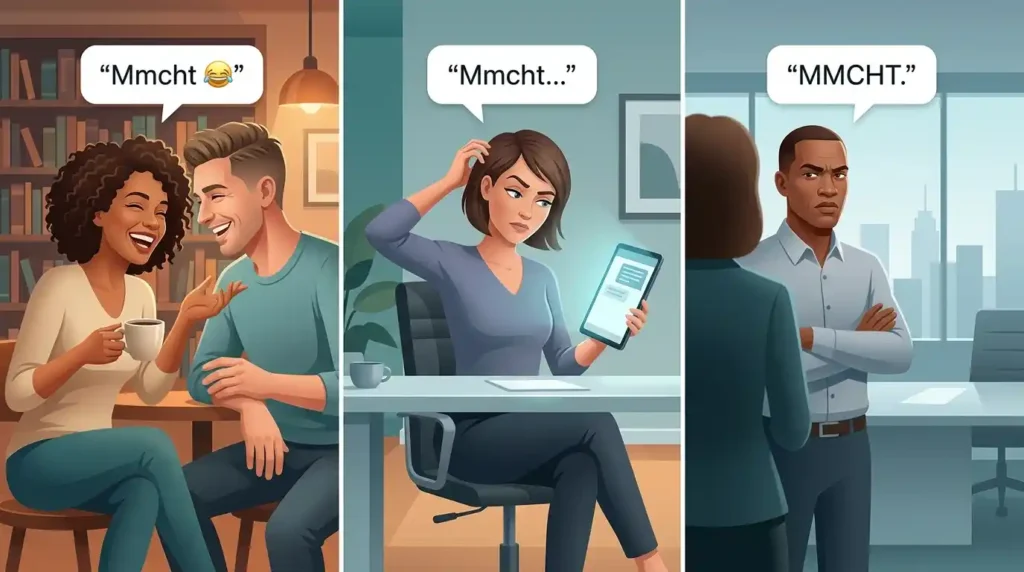
It can sound:
- Annoyed — “Mmcht, you forgot again.”
- Dismissive — “Mmcht, whatever.”
- Skeptical — “Mmcht, I don’t believe that.”
- Disapproving — “Mmcht, that’s not okay.”
- Playful — “Mmcht 😂 you’re ridiculous.”
- Sarcastic — “Mmcht, sure you did.”
- Dramatic — “MMCHT 😭 no way!”
Capitalization, punctuation, and emojis can change how the expression feels. “mmcht 😂” may be playful, while “MMCHT.” can feel much more serious.
Is MMCHT Rude or Offensive?
MMCHT can sound rude or dismissive, especially when it is directed at someone’s statement during an argument.
It is not automatically offensive, but it can communicate disapproval, irritation, or attitude.
With Friends
It can be perfectly natural when friends use it jokingly.
Social Media
It may work as an informal reaction, especially when the comment is playful or expressive.
School
It is better to avoid MMCHT when communicating with teachers or school staff because the tone may be unclear or disrespectful.
Work
MMCHT is not appropriate for professional emails, workplace messages, or formal communication.
Formal Writing
Do not use MMCHT in essays, reports, applications, or other formal writing.
If someone sends it to you and you’re unsure whether they are joking, look at the conversation before assuming they are angry.
Other Meanings of MMCHT
MMCHT is unusually ambiguous online. Some pages claim that it is an acronym for specific phrases, but these definitions conflict with one another and lack a consistent standard.
For that reason, there is no important established technology, gaming, business, finance, medical, or sports meaning that should automatically replace the informal reaction meaning in a text conversation.
If you see MMCHT in a specialized setting, check the surrounding terminology or ask the sender what they mean rather than assuming a particular expansion.
Common Mistakes About MMCHT
Assuming It Is a Traditional Acronym
MMCHT may look like an acronym, but current slang references more consistently describe it as a sound-based reaction.
Assuming It Always Means Anger
It can express annoyance, but it can also show disbelief, skepticism, teasing, or playful attitude.
Treating Every “MMCHT” as the Same
The meaning can shift depending on what happened immediately before the message.
Assuming It Means Flirting
MMCHT does not automatically indicate attraction, flirting, or romantic interest.
Trusting a Random Full Form
Because online definitions conflict, it is safer to interpret MMCHT from context and tone than to memorize an unsupported expansion.
MMCHT and Related Slang
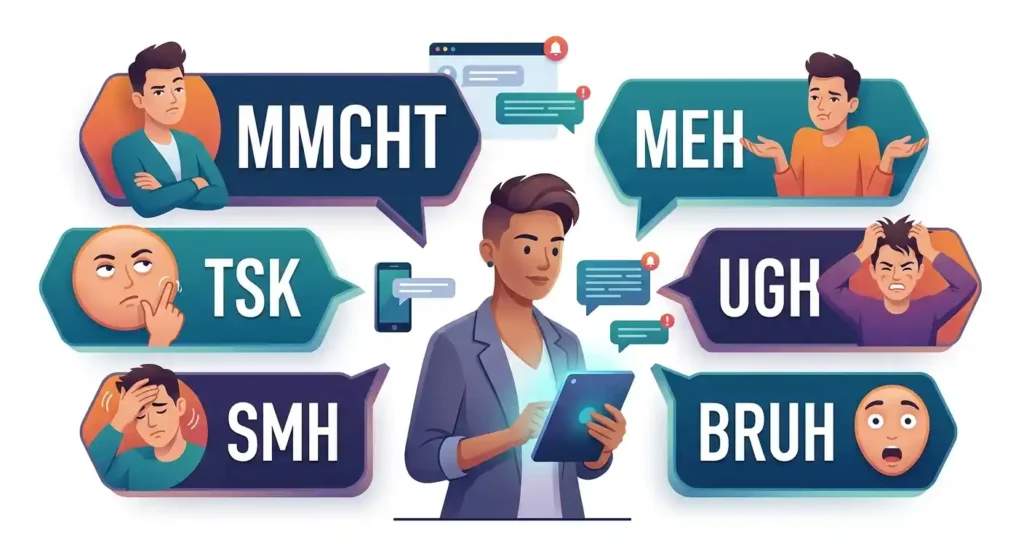
| Term | Meaning | Common Use |
|---|---|---|
| MMCHT | Expressive reaction showing attitude or disapproval | Casual texting |
| Tsk | Sound expressing annoyance or disapproval | Written reaction |
| SMH | Shaking my head | Disbelief or disappointment |
| Meh | Indifference or lack of enthusiasm | Casual reactions |
| Ugh | Frustration, annoyance, or dislike | Everyday texting |
| Bruh | Surprise, disbelief, or frustration | Informal chat |
These terms are related because they communicate emotion or attitude quickly, rather than simply replacing a long sentence.
People Also Ask About MMCHT
Is MMCHT an acronym?
Not in the usual sense. Current references more consistently describe MMCHT as a sound-based or phonetic expression, so it does not have one reliable full form.
What does MMCHT mean in simple words?
It is roughly a written reaction showing annoyance, disbelief, skepticism, disapproval, or an unimpressed attitude. Depending on the conversation, it can be similar to “seriously?” or “come on.”
Is MMCHT a bad word?
MMCHT itself is not a conventional profanity. However, it can sound rude, dismissive, or disrespectful, depending on how it is directed at someone.
What does MMCHT mean from a girl or guy?
The basic meaning does not change based on whether the sender is a girl or guy. Context, relationship, punctuation, emojis, and the previous conversation are more useful clues.
Can MMCHT be playful?
Yes. Between friends, MMCHT can be a humorous or exaggerated reaction to something surprising or ridiculous.
What should I say when someone texts MMCHT?
If it seems playful, you can respond with humor. If you cannot tell whether the person is annoyed, a neutral reply such as “What do you mean?” or “Are you serious?” can help clarify the tone.
Does MMCHT have a fixed full form?
No universally accepted full form is established. Several conflicting expansions appear online, which is why treating MMCHT as a reaction sound is more reliable in ordinary texting.
Conclusion
MMCHT is generally an informal written reaction sound used to express annoyance, disbelief, skepticism, disapproval, or attitude. It is not a standard acronym with one confirmed full form.
The exact tone can range from playful and sarcastic to genuinely irritated, so the surrounding conversation matters. It is suitable mainly for casual communication and should generally be avoided in school, workplace, and formal writing.
When you see MMCHT in a message, focus on what was said immediately before it, the punctuation, emojis, and your relationship with the sender. Those clues usually reveal whether it means “seriously?”, “come on,” “I don’t believe you,” or simply a playful reaction.

Emma Brooks is a writer whose work centers on puns, jokes, and topic-specific wordplay. Across four and a half years of experience, she has covered subjects involving food, animals, seasonal occasions, technology, entertainment, and trending topics. Emma identifies useful terms, tests different joke angles, and revises setups and punchlines to strengthen wording and comedic delivery.