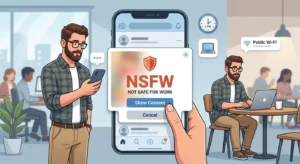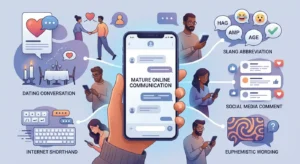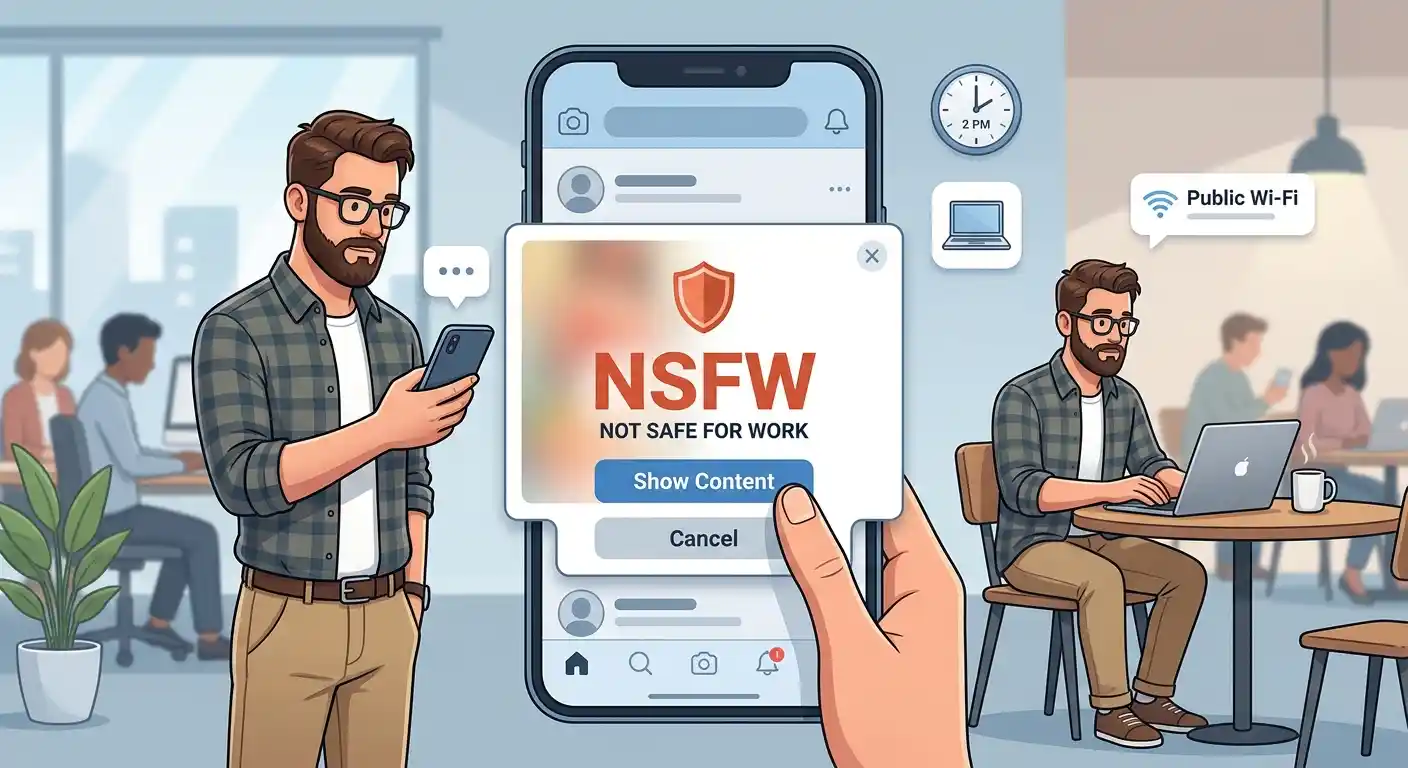
NSFW terminology refers to words, labels, and abbreviations used to describe content that may be inappropriate to view in a workplace or other public setting. The best-known term is NSFW, meaning “Not Safe for Work,” a content warning commonly associated with sexual, graphic, offensive, or otherwise unsuitable material.
Key Takeaways
- NSFW stands for “Not Safe for Work” and can also be understood as “Not Suitable for Work.”
- NSFW is an internet initialism and content-warning label, rather than a description of one specific type of material.
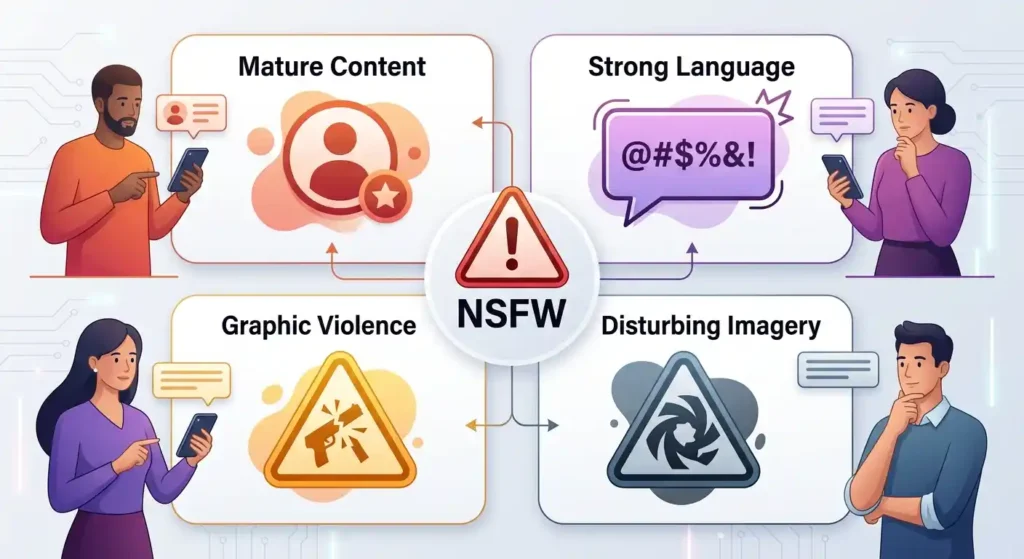
- It can refer to nudity, sexual material, profanity, graphic violence, disturbing imagery, or other content that may be unsuitable for a workplace or public setting.
- SFW means “Safe for Work” and is used for content considered suitable for a work or public environment.
- NSFL means “Not Safe for Life” and is generally used for especially disturbing or graphic material.
- NSFW terminology is mainly used in online communication, including posts, links, images, videos, messages, and other digital content.
NSFW Terminology Meaning in Text
NSFW terminology is the broader language people use when labeling, describing, or discussing content that may not be appropriate to view in public, at work, or around people who have not chosen to see it.
The central term is NSFW, which means “Not Safe for Work.” Dictionaries describe it as an abbreviation used to warn people that online material may be inappropriate to view at work or in another public setting.
The term is not limited to sexual content. Depending on context, an NSFW label can apply to:
- Nudity
- Sexual or adult material
- Strong profanity
- Graphic violence
- Disturbing images
- Offensive material
- Other content that may be inappropriate for a workplace or public setting
In texting and social media, NSFW works as a warning. For example, someone might send, “NSFW—don’t open this at work.” The label gives the recipient a chance to decide whether and where to view the content.
What Does NSFW Stand For?
NSFW stands for “Not Safe for Work.” Another documented wording is “Not Suitable for Work.” Both describe the same basic idea: content that may not be appropriate to view in a workplace.
NSFW is an initialism, meaning the letters are generally read individually: N-S-F-W. It developed as internet shorthand and is now recognized as part of online and texting terminology.
The important point is that NSFW is a warning label, not a precise content category. Two posts can both be marked NSFW for completely different reasons.
How Is NSFW Terminology Used?
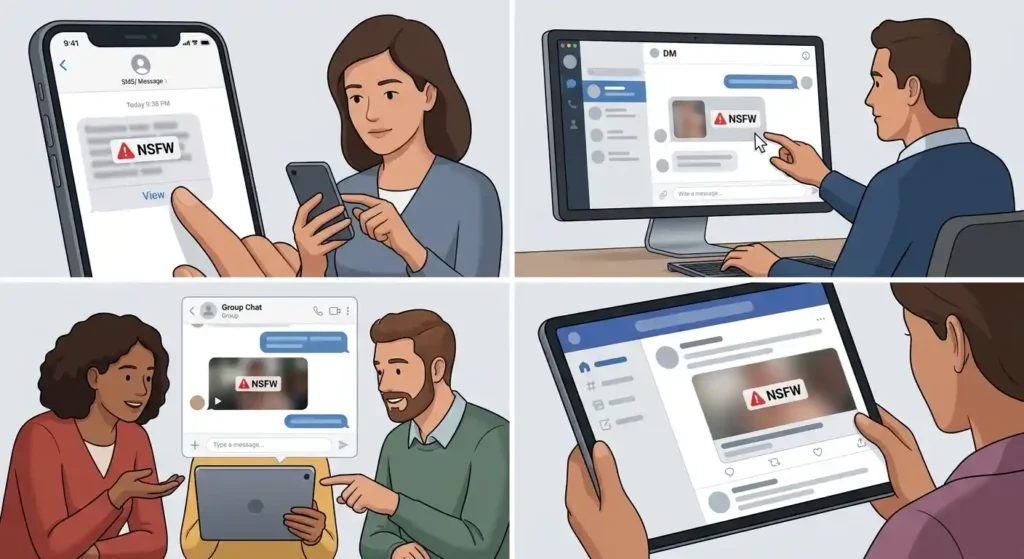
Text Messages
Someone may write “NSFW” before sending a photo, video, link, or other material that could be inappropriate to open around coworkers or other people.
Example:
“NSFW 😂 Don’t open this during the meeting.”
DMs
In private messages, NSFW can act as a quick warning before someone shares potentially sensitive or adult material.
Group Chats
A person may add NSFW before a link, image, or video so other members know what kind of content they may encounter.
Social Media
NSFW terminology can appear in posts, comments, descriptions, hashtags, or content labels. Online communities may use warnings to help viewers decide whether they want to open particular material.
Online Communities
NSFW is especially useful when a post contains material that could be embarrassing, offensive, graphic, or unsuitable for a shared environment.
NSFW Terminology in Different Contexts
From a Friend
If a friend texts “NSFW” before a link, they are generally warning you that the content may not be appropriate to open around other people.
From a Guy
The meaning does not change because the sender is a guy. Look at the content and surrounding message rather than the sender’s gender.
From a Girl
Likewise, a girl using NSFW is generally using the same content-warning terminology. Gender does not create a separate meaning.
From a Crush
If a crush sends something marked NSFW, the label tells you something about the content, not automatically about their romantic feelings. NSFW by itself does not prove flirting or attraction.
In Dating
In dating conversations, NSFW may describe adult or sexually suggestive material. However, seeing the label alone does not establish what the sender wants from the relationship.
In a Relationship
Partners may use NSFW to warn each other about sensitive or adult material. The meaning still depends on the actual content and conversation.
In a Group Chat
NSFW can help people recognize that a link, image, or video may not be suitable to open in a public setting.
In Social Media Comments
A comment such as “NSFW” can function as a warning to other readers when the post contains potentially unsuitable material.
Real Chat Examples
- Friend: “I found the funniest video.”
You: “Is it NSFW?” - Friend: “Yeah, probably don’t open it at work 😂”
- Friend: “NSFW warning before you click.”
- Friend: “This picture is NSFW.”
- You: “Can I open that around my coworkers?”
Friend: “Nope. NSFW.” - Friend: “Sending you a link. NSFW.”
- Friend: “Don’t open this during class. NSFW.”
- Friend: “Is that post SFW?”
You: “Definitely not.” - Friend: “I marked the post NSFW just in case.”
- Friend: “That video needs an NSFW warning.”
- You: “Why did you label it NSFW?”
Friend: “There’s some graphic footage in it.” - Friend: “NSFW—watch it privately.”
- Friend: “This meme looks innocent, but it’s definitely NSFW.”
- You: “What’s in the link?”
Friend: “Just trust me, NSFW.” - Friend: “I wouldn’t play that video at work.”
- You: “So it’s NSFW?”
Friend: “Exactly.” - Friend: “I forgot my boss was standing behind me when I opened that NSFW link.”
- Friend: “Tag that NSFW before posting it.”
- You: “Is it sexual?”
Friend: “Not necessarily. It’s just graphic.” - Friend: “This one is SFW; the next one is NSFW.”
How to Reply to NSFW Terminology
Casual Replies
- “Got it.”
- “Thanks for the warning.”
- “I’ll check it later.”
- “Okay, noted.”
- “I’ll wait until I’m home.”
Friendly Replies
- “LOL, now I’m curious.”
- “Thanks for the heads-up.”
- “I’ll open it when I’m somewhere private.”
- “Good call warning me first.”
Funny Replies
- “My boss doesn’t need to see that 😂”
- “Saving that for after work.”
- “You had me at ‘NSFW.’”
- “Definitely not opening that on the office Wi-Fi 😂”
Neutral Replies
- “What kind of content is it?”
- “Is it safe to open in public?”
- “I’ll view it later.”
- “Thanks for letting me know.”
Flirty/Relationship Replies
If the conversation is already romantic and the content itself is clearly adult or suggestive, natural replies could include:
- “I’ll save it for later 😉”
- “Okay, I’ll wait until I’m somewhere private.”
- “Now I’m curious what you sent.”
The NSFW label itself does not establish romantic intent.
What Tone Does NSFW Terminology Have?
NSFW usually has a direct, informal, and cautionary tone.
Depending on the situation, it can feel:
- Informal
- Neutral
- Direct
- Cautionary
- Playful
- Matter-of-fact
- Context-dependent
The purpose is usually practical: give the reader a warning before they encounter potentially unsuitable content.
The term does not automatically express anger, excitement, attraction, or another emotion.
Is NSFW Terminology Rude or Offensive?
NSFW itself is not inherently rude or offensive. It is primarily a content warning.
It is generally suitable for:
- Casual conversations
- Friends
- Online communities
- Social media
- Informal messages
In professional communication, a clearer phrase such as “contains mature content” or “not appropriate for workplace viewing” may be easier for everyone to understand.
Also, NSFW does not necessarily mean the content is illegal or dangerous. It simply signals that the material may be unsuitable for a particular environment.
Other Meanings of NSFW Terminology
NSFW in Online Content
The primary meaning remains “Not Safe for Work.” It is used as a warning attached to or associated with digital material that may be inappropriate for work or other public settings.
NSFW is not a standard medical, scientific, or technical diagnosis. When the letters appear in a specialized document, the surrounding terminology should be checked rather than automatically assuming the internet meaning.
Common Mistakes About NSFW Terminology
Assuming NSFW Always Means Porn
NSFW can describe sexual or adult content, but it can also warn about profanity, graphic violence, disturbing imagery, or other unsuitable material.
Confusing NSFW With NSFL
NSFW generally warns about content unsuitable for work or public viewing. NSFL is a stronger warning generally associated with extremely disturbing or graphic material.
Assuming NSFW Means Something Is Illegal
An NSFW label is a content warning. It does not, by itself, tell you whether something is legal or illegal.
Assuming NSFW Proves Sexual Intent
If someone sends you an NSFW-labeled message, the label describes the content. It does not automatically prove flirting, attraction, or a desire for a sexual relationship.
Treating NSFW as a Professional Term
NSFW is internet shorthand. In formal workplace communication, spelling out the warning is usually clearer.
NSFW Terminology and Related Slang
| Term | Meaning | Common Use |
| NSFW | Not Safe for Work | Warning about potentially unsuitable content |
| SFW | Safe for Work | Indicates content is suitable for a work/public setting |
| NSFL | Not Safe for Life | Warning about especially disturbing or graphic content |
| 18+ | Adults only | Indicates an age restriction or adult-oriented material |
| Mature content | Content intended for mature audiences | Broader warning for adult or sensitive material |
SFW is the direct counterpart of NSFW, while NSFL generally signals a more disturbing category of material.
People Also Ask About NSFW Terminology
What is the difference between NSFW and SFW?
NSFW means “Not Safe for Work” and warns that content may be unsuitable for a workplace or public setting. SFW means “Safe for Work” and indicates that content is considered suitable for that environment.
Does NSFW always mean sexual content?
No. Sexual or adult material is one common reason for an NSFW warning, but the label can also apply to nudity, profanity, graphic violence, disturbing imagery, or other inappropriate material.
What does NSFL mean?
NSFL means “Not Safe for Life.” It is internet slang generally used as a warning for especially disturbing or graphic content, such as severe gore or real-world violence.
What does SFW mean in texting?
SFW means “Safe for Work.” In texting and online communication, it tells someone that the referenced content should be suitable to view in a workplace or other public setting.
Is NSFW a warning or a category?
It is primarily a warning label. It does not identify one exact type of content; it tells viewers that the material may be unsuitable for their current environment.
How do you pronounce NSFW?
NSFW is commonly pronounced by saying the letters individually: “N-S-F-W.” It can also be spoken as the full phrase, “not safe for work.”
Can something be NSFW without being sexual?
Yes. Graphic violence, disturbing imagery, strong profanity, and other potentially inappropriate material can also receive an NSFW warning.
Does NSFW mean I should not look at something at all?
Not necessarily. The warning mainly tells you to consider where and around whom you are viewing the material. Whether you choose to view it depends on the content, setting, and applicable rules.
Conclusion
NSFW terminology centers on the internet warning “Not Safe for Work.” It describes language used to identify content that may be unsuitable for a workplace or public setting, including sexual, graphic, offensive, or otherwise sensitive material. Related terms such as SFW and NSFL provide additional context, while the exact meaning and seriousness of a warning depend on the content and situation.

Emma Brooks is a writer whose work centers on puns, jokes, and topic-specific wordplay. Across four and a half years of experience, she has covered subjects involving food, animals, seasonal occasions, technology, entertainment, and trending topics. Emma identifies useful terms, tests different joke angles, and revises setups and punchlines to strengthen wording and comedic delivery.