STTM most commonly means “Stop Talking To Me” in text messages and online chat. It is an informal texting abbreviation that can sound serious, annoyed, or playful depending on the conversation and relationship between the people involved.
Key Takeaways
- STTM usually stands for “Stop Talking To Me.”
- It is mainly used as informal text slang in casual online communication.
- The phrase can be serious when someone genuinely wants a conversation to stop.
- Friends may also use STTM playfully or dramatically after a joke, tease, or embarrassing comment.
- Context matters: punctuation, emojis, previous messages, and the relationship can change how STTM sounds.
- Because it can come across as dismissive, it is generally better suited to casual conversations than formal communication.
STTM Meaning in Text
In texting, STTM means “Stop Talking To Me.” It is a slang acronym formed from the first letters of the words in the phrase.
Someone may send STTM when they want another person to stop talking, stop teasing them, or end the current conversation. The abbreviation itself does not tell you whether the person is genuinely upset or joking.
For example:
“You really posted that picture? STTM 😂”
Here, the laughing emoji and playful context suggest that STTM may be a joking reaction rather than a serious request.
By contrast:
“STTM. I don’t want to talk about this anymore.”
This version sounds much more serious because the surrounding message clearly asks for the conversation to end.
STTM is best understood as informal online communication shorthand, rather than a phrase you would normally use in professional or formal writing.
What Does STTM Stand For?
STTM stands for “Stop Talking To Me.”
It is an initialism or texting abbreviation. The letters represent:
- S = Stop
- T = Talking
- T = To
- M = Me
Unlike some abbreviations with a single standardized definition, STTM can occasionally be interpreted differently in specific communities. However, when the question is specifically about texting slang, “Stop Talking To Me” is the clearest interpretation.
How Is STTM Used?
STTM is most useful when the conversation is informal. You may see it in:
- Text messages
- DMs
- Group chats
- Social media conversations
- Comments or replies
- Casual online communities
It can be used as a direct statement:
“STTM, I’m trying to study.”
Or as a playful reaction:
“You ate the last slice? STTM 😂”
The surrounding message is important. If someone sends only “STTM” without an emoji or explanation, it can be harder to tell whether they are joking or genuinely asking for space.
STTM in Different Contexts
The meaning of STTM generally stays the same, but the tone can change significantly based on context.
From a Friend
Between friends, STTM may be playful.
“You showed everyone my old photo? STTM 😭”
The phrase may simply mean, “I can’t believe you did that,” rather than a serious request to stop communicating.
From Someone You’re Dating
If someone you’re dating sends STTM during an argument, it may be a genuine request to stop the conversation for the moment.
It is better to consider the entire conversation rather than assuming the abbreviation automatically means the relationship is ending.
In a Group Chat
In a group chat, STTM can be a humorous reaction to teasing, an embarrassing story, or an annoying topic.
For example:
“Bro posted his karaoke video again.”
“STTM 😂”
The joking context changes how the abbreviation is likely to be understood.
In Social Media Comments
In comments or replies, STTM can function as a short reaction to something someone posted. Without additional context, however, it may sound blunt.
Does STTM Mean Something Different From a Guy or Girl?
Not necessarily. Gender does not automatically change the meaning of STTM.
Whether the sender is a guy or a girl, look at:
- What was said immediately before STTM
- Their usual communication style
- Punctuation
- Emojis
- Your relationship with them
- Whether you were joking or arguing
The abbreviation by itself does not prove flirting, anger, rejection, or romantic interest.
Real Chat Examples
Here are realistic ways STTM can appear in casual conversations:
- Friend: “I just sent your embarrassing selfie to the group.”
You: “STTM 😭” - A: “You still haven’t watched that movie?”
B: “STTM 😂” - A: “I’m going to tell everyone what happened.”
B: “STTM.” - Friend: “Guess who I saw at the mall?”
You: “STTM, don’t tell me.” - A: “I beat your high score again.”
B: “STTM 😭” - Friend: “I’m bringing up that story at dinner.”
You: “STTM please.” - A: “You’re still arguing about this?”
B: “STTM.” - Friend: “I found your old school pictures.”
You: “STTM 😂” - A: “Can we talk about what happened yesterday?”
B: “STTM. I’m not ready to discuss it.” - Friend: “I’m sending that screenshot to everyone.”
You: “STTM 😭” - A: “You know I’m right.”
B: “STTM lol.” - Friend: “Should I tell them your secret?”
You: “STTM 😂” - A: “I’m going to keep teasing you.”
B: “STTM.” - Friend: “Remember when you fell during practice?”
You: “STTM, why would you bring that up?” - A: “We need to keep talking about this.”
B: “STTM. I need a break.” - Friend: “I’m posting the video.”
You: “STTM 😭” - A: “You can’t escape this conversation.”
B: “STTM 😂” - Friend: “I know what you did last weekend.”
You: “STTM right now.”
These examples show why context matters more than the four letters alone.
How to Reply to STTM
Your response should depend on whether the sender appears to be joking or serious.
Casual Replies
- “Okay 😂”
- “Fine, fine.”
- “My bad lol.”
- “I’ll stop.”
- “Got you.”
Friendly Replies
- “Okay, I’ll leave you alone for now.”
- “Haha, I get the hint.”
- “No worries.”
- “All good.”
Funny Replies
If your friendship clearly supports joking:
- “Too late 😂”
- “You’ll survive.”
- “I have more to say 😭”
- “Okay, dramatic.”
Neutral Replies
If you’re unsure whether they are serious:
- “Okay. Do you want some space?”
- “Got it. We can talk later.”
- “No problem.”
- “I’ll give you some time.”
Flirty/Relationship Replies
There is no special romantic meaning built into STTM. If the conversation is clearly playful, you can respond naturally, but don’t assume STTM is flirting by itself.
If you’re unsure, a simple response such as “Okay, I’ll give you some space” avoids misunderstanding.
What Tone Does STTM Have?
STTM is context-dependent, but several tones are possible.
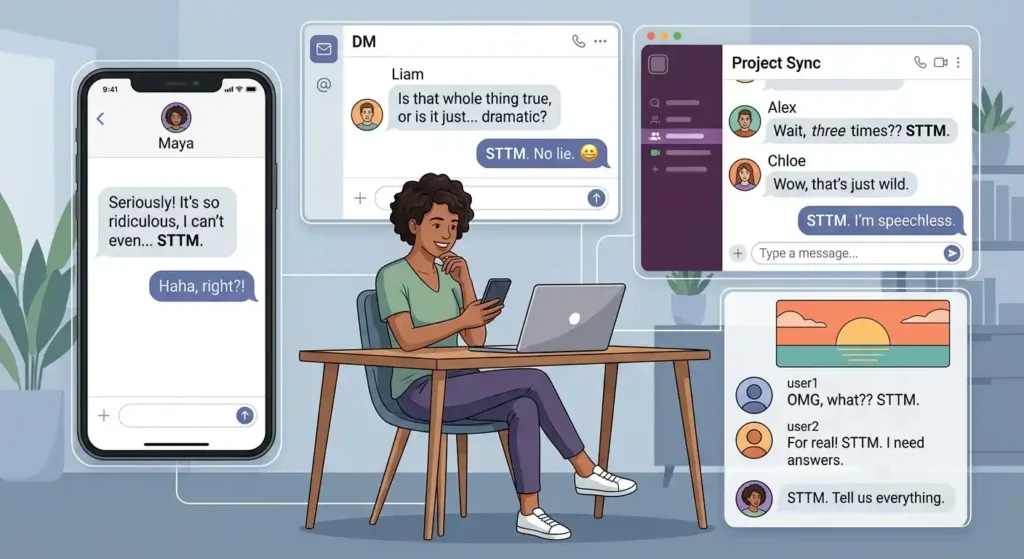
- Direct: It can plainly tell someone to stop talking.
- Annoyed: It may express frustration with a conversation.
- Playful: Friends may use it jokingly after teasing.
- Dramatic: Someone may exaggerate their reaction for humor.
- Serious: It can be a genuine request for someone to stop communicating.
- Informal: The abbreviation is designed for casual online communication.
An emoji can make a difference. “STTM 😂” may feel much lighter than “STTM.” Still, the full conversation is a better guide than the emoji alone.
Is STTM Rude or Offensive?
STTM is not inherently offensive, but it can sound rude or dismissive.
With close friends, it may be harmless joking. In a serious conversation, however, telling someone to “stop talking to me” can sound abrupt.
It is generally:
- Fine for casual chats: Depending on the relationship and tone.
- Possible on social media: Especially as a humorous reaction.
- Less suitable for school communication: A more respectful phrase is usually better.
- Poor for professional communication: Use clear, polite language instead.
- Not appropriate for formal writing: Write the full thought instead of using texting slang.
If you are unsure how the recipient will interpret it, avoid STTM and say what you actually mean.
Other Meanings of STTM
STTM is not limited to one universally recognized expansion across every subject. In particular, online communities may create their own abbreviations.
For texting and casual chat, however, “Stop Talking To Me” is the main meaning relevant to this keyword.
Some online pages suggest other expansions for STTM, but they are not consistent enough to treat as universal texting meanings. If STTM appears in a specialized workplace, technical, academic, or community-specific conversation, the surrounding context should determine the interpretation.
Common Mistakes About STTM
Assuming STTM Always Means Someone Is Angry
Not necessarily. Friends can use STTM jokingly, especially with laughing or crying emojis.
Assuming It Means the Person Hates You
STTM literally asks someone to stop talking, but it does not automatically explain why. A person could be joking, irritated about a specific topic, or genuinely asking for space.
Ignoring the Conversation Around It
Looking only at the abbreviation can lead to a wrong interpretation. Read the messages immediately before and after it.
Treating It Like Formal Language
STTM is texting shorthand. It is better suited to casual communication than professional emails, school assignments, or formal messages.
Assuming Gender Changes the Meaning
A guy and a girl can use STTM with the same basic meaning. The person’s wording, relationship with you, and context matter more than gender.
STTM and Related Slang
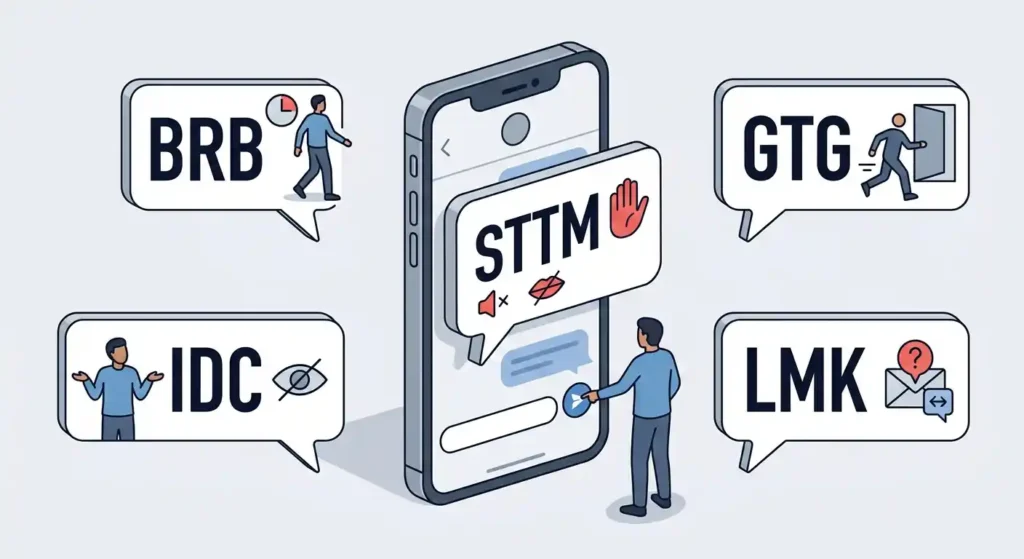
| Term | Meaning | Common Use |
|---|---|---|
| STTM | Stop Talking To Me | Telling someone to stop talking, sometimes jokingly |
| STFU | Shut the F*** Up | A much harsher way to tell someone to stop talking |
| BRB | Be Right Back | Temporarily leaving a conversation |
| GTG | Got To Go | Ending or leaving a conversation |
| IDC | I Don’t Care | Showing a lack of concern or interest |
| LMK | Let Me Know | Asking someone to provide information later |
The important distinction is that STTM directly relates to stopping a conversation, while terms such as BRB and GTG generally describe leaving temporarily or ending a chat for another reason.
People Also Ask About STTM
What does STTM mean in texting?
STTM most commonly means “Stop Talking To Me.” It can be serious or playful depending on the surrounding conversation.
Is STTM a bad word?
No. STTM itself is not a swear word. However, saying “stop talking to me” can sound blunt or rude depending on how it is used.
What does STTM mean from a friend?
A friend may use STTM jokingly after teasing, embarrassing you, or saying something you find ridiculous. Their usual communication style and the surrounding messages can help you tell whether it is serious.
Does STTM mean “leave me alone”?
It can communicate a similar idea. When used seriously, STTM indicates that the sender does not want the conversation to continue.
Is STTM formal or informal?
STTM is informal texting shorthand. It is generally better suited to casual conversations than school, workplace, or professional communication.
Can STTM be used jokingly?
Yes. A person may use it as an exaggerated reaction among friends. Emojis, humor, and the preceding conversation can make that playful meaning clearer.
What should I say if someone texts STTM?
If you’re unsure whether they are joking, a calm response such as “Okay, I’ll give you some space” is a safe choice. If the conversation was clearly playful, a light response may fit better.
Conclusion
STTM meaning in text is most commonly “Stop Talking To Me.” It is an informal texting abbreviation used to ask someone to stop talking or end a conversation.
The tone can range from serious and direct to playful and dramatic, so context matters. Friends may use it as a joke, while someone in a tense conversation may genuinely want space.
Because STTM can sound dismissive, it is best kept to casual communication. When you see it in a message, check the surrounding words, punctuation, emojis, and relationship before deciding exactly how serious the sender is.

Emma Brooks is a writer whose work centers on puns, jokes, and topic-specific wordplay. Across four and a half years of experience, she has covered subjects involving food, animals, seasonal occasions, technology, entertainment, and trending topics. Emma identifies useful terms, tests different joke angles, and revises setups and punchlines to strengthen wording and comedic delivery.