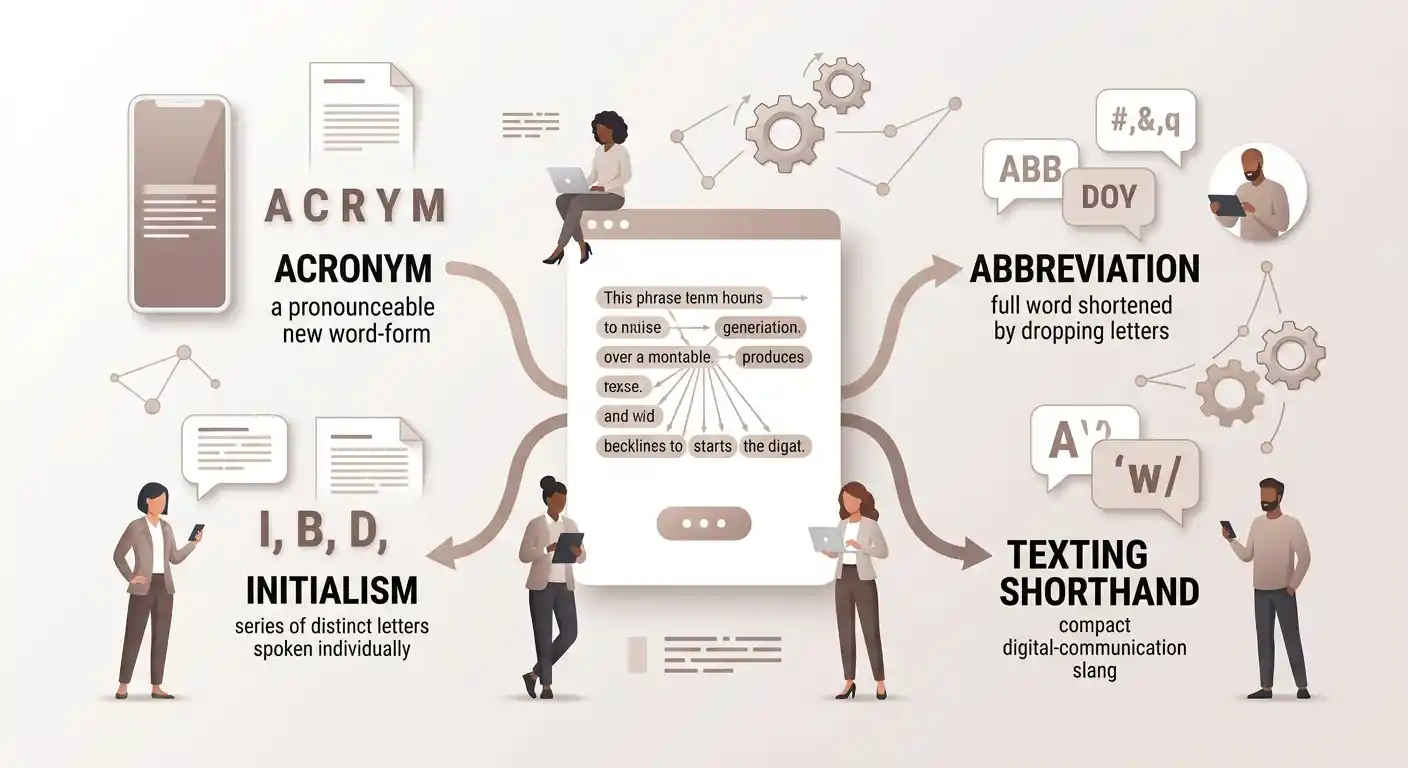
Less common acronyms are shortened phrases that appear in texts, chats, social media, and online communities but may not be familiar to everyone. Unlike widely recognized terms such as LOL or BTW, their meanings can depend heavily on context.
Key Takeaways
- Less common acronyms are usually abbreviations that have narrower or less familiar usage.
- Their meanings can change depending on the conversation, platform, or community.
- Some are older texting shortcuts that have become less common over time.
- A few acronyms can have multiple meanings, so surrounding words matter.
- Examples include terms such as CU, CUL8R, F2F, IC, OIC, and HAND in older or less-common texting usage.
- If an unfamiliar acronym does not make sense, checking the context is more reliable than assuming one fixed meaning.
What Are Less Common Acronyms?
Less common acronyms are shortened forms of words or phrases that are recognized in particular conversations, communities, or situations but are not as universally familiar as common texting abbreviations.
For example, F2F means “face to face,” while OIC can mean “oh, I see.” These are understandable once explained, but they are less immediately recognizable than abbreviations such as LOL, BTW, or BRB.
In online communication, an unfamiliar acronym may also be specific to a particular community. An abbreviation used in one group may be unfamiliar to people outside that group.
What Do Less Common Acronyms Stand For?
There is no single expansion because “less common acronyms” describes a category rather than one specific acronym.
Some examples include:
| Acronym | Meaning | Common Use |
|---|---|---|
| CU | See you | Informal goodbye |
| CUL8R | See you later | Older text shorthand |
| F2F | Face to face | In-person communication |
| IC | I see | Acknowledgment |
| OIC | Oh, I see | Showing understanding |
| HAND | Have a nice day | Informal sign-off |
| PLS | Please | Casual messaging |
| PLZ | Please | Text shorthand |
| W/ | With | Informal abbreviation |
Several of these are described as less common or older texting forms, rather than terms people need to use regularly today.
How Are Less Common Acronyms Used?
Less common acronyms can appear in:
- Text messages
- Direct messages
- Group chats
- Social media conversations
- Online communities
- Gaming chats
- Informal conversations
Their usefulness depends on whether the other person understands them. Texting abbreviations can make messages shorter, but unfamiliar shorthand can also make a message harder to understand.
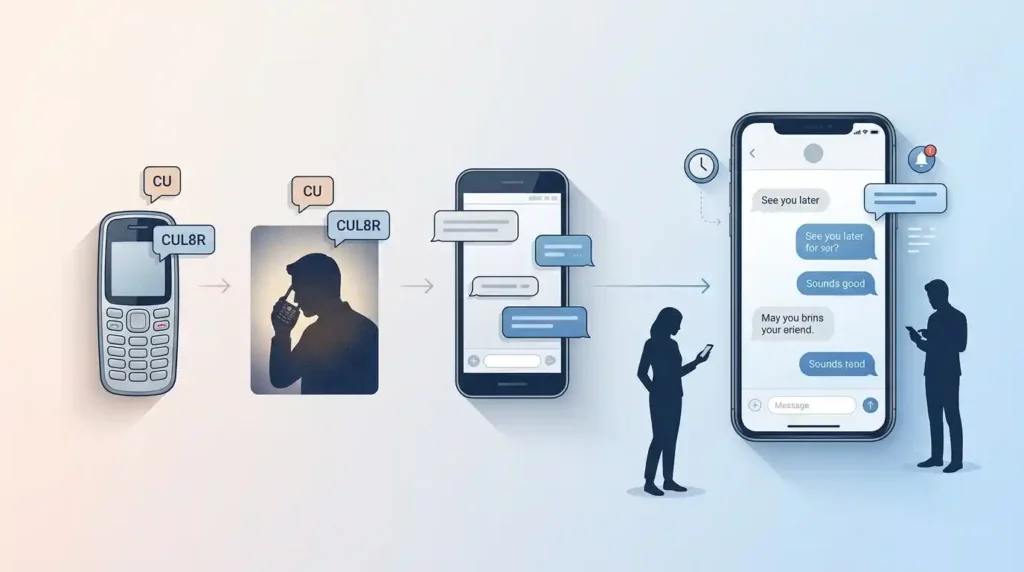
Some older forms, such as CU and CUL8R, have become less common as texting habits have changed.
Less Common Acronyms in Different Contexts
Context is especially important with unfamiliar acronyms.
In a Text Message
If someone sends an unusual abbreviation in a casual text, it may simply be shorthand for a longer phrase.
In a Group Chat
A group may develop its own abbreviations. A term that seems confusing to an outsider may be obvious to regular members.
On Social Media
Online communities can create specialized shorthand that depends on the topic or community.
In Gaming
Gaming communities can use abbreviations connected to specific games, strategies, roles, or conversations.
In a Relationship or Friendship
An unfamiliar acronym does not automatically indicate flirting, affection, anger, or another specific emotion. The surrounding conversation provides more useful clues than the abbreviation alone.
Real Chat Examples
Here are examples showing how less common acronyms can appear naturally:
- “CU tomorrow!” — “See you tomorrow!”
- “CUL8R, I have to go.” — “See you later.”
- “Can we talk F2F?” — “Can we talk face to face?”
- “IC, that makes sense.” — “I see.”
- “OIC 😂 I get it now.” — “Oh, I see.”
- “HAND!” — “Have a nice day!”
- “PLS send me the address.” — “Please send me the address.”
- “PLZ don’t forget.” — “Please don’t forget.”
- “I’ll meet you F2F tomorrow.”
- “OIC what you mean now.”
- “CU after class.”
- “CUL8R, I’m heading out.”
- “IC why you were confused.”
- “PLS let me know when you arrive.”
- “F2F would probably be easier.”
- “OIC! That explains everything.”
- “CU soon!”
- “HAND, everyone!”
- “PLZ check the message again.”
- “IC, thanks for explaining.”
Funny, Made-Up Acronym Ideas
If you’re looking for creative/funny acronyms rather than established slang, these can work as jokes:
- NATM — Not Again, This Morning 😭
- IDWTM — I Don’t Want To Move 😂
- WTFM — Why This Food Missing? 🍕
- GIMME — Get It, Make Me Eat 😆
- TMB — Text Me Back 👀
- NMP — Not My Problem 😎
- HMB — Hold My Brain 🧠
- DND — Do Not Disturb
- MIA — Missing In Action
- SOS — Send Snacks Immediately 🍿
These examples illustrate the basic functions of less common shorthand rather than suggesting that every term is equally common today.
How to Reply to Less Common Acronyms
When someone uses an acronym you understand, reply normally according to the conversation.
Casual Replies
- “Yep, see you!”
- “Got it.”
- “Sounds good.”
- “Okay, thanks!”
Friendly Replies
- “Haha, I get you now.”
- “Sure, talk later!”
- “That makes sense.”
Funny Replies
If the acronym itself is unusual, you can respond playfully:
- “Okay, I had to decode that one 😂”
- “That acronym took me a second.”
- “I finally figured it out 😂”
Neutral Replies
If you do not understand the abbreviation, simply ask:
- “What does that mean?”
- “What does that abbreviation stand for?”
- “Sorry, I’m not familiar with that one.”
Asking is often better than guessing when the abbreviation could have multiple meanings.
What Tone Do Less Common Acronyms Have?
The tone depends on the individual acronym and the surrounding message.
Less common texting abbreviations can be:
- Casual
- Informal
- Friendly
- Playful
- Direct
- Context-dependent
The abbreviation itself does not necessarily determine the sender’s emotional intent. Punctuation, emojis, surrounding words, and the subject of the conversation can change how a message feels.
Are Less Common Acronyms Rude or Offensive?
Most ordinary texting abbreviations are not inherently rude or offensive.
However, unfamiliar shorthand can cause confusion, especially in formal situations. Acronyms that are acceptable in a casual group chat may not be appropriate in a school assignment, professional email, or formal document.
For school or professional communication, spelling out an unfamiliar abbreviation is usually clearer unless the abbreviation is already well established in that setting.
Other Meanings of Less Common Acronyms
In Technology
Acronyms are widely used in technology, where a short form can have a completely different meaning from its texting meaning. The surrounding technical topic is important when interpreting one.
In Gaming
Gaming communities often develop specialized shorthand. A gaming acronym may refer to a game mechanic, character, strategy, or community-specific expression.
In Business
Business communication uses many abbreviations, but these should not automatically be interpreted as internet slang. Workplace acronyms often refer to departments, processes, job roles, or business terms.
In Medical Terms
Medical abbreviations are another separate category. A medical abbreviation should be interpreted from the medical context rather than assumed to be texting slang.
Common Mistakes About Less Common Acronyms
Assuming Every Acronym Has One Meaning
Some abbreviations can have multiple expansions. Context helps determine which interpretation fits.
Treating Old Texting Slang as Current Everyday Language
Some older shortcuts remain recognizable but are less common in modern messaging. CU and CUL8R, for example, are identified as older or fading texting forms.
Assuming an Unfamiliar Acronym Is a Typo
An unusual-looking abbreviation may be intentional shorthand.
Assuming the Acronym Reveals Romantic Intent
A texting abbreviation alone does not establish flirting or romantic interest. Look at the complete conversation and the relationship between the people involved.
Confusing Text Slang With Professional Acronyms
An abbreviation can belong to a technical, business, medical, or other specialized context rather than internet slang.
Less Common Acronyms vs. Common Texting Acronyms
| Term | Meaning | Typical Use |
|---|---|---|
| CU | See you | Older casual texting |
| CUL8R | See you later | Older casual texting |
| F2F | Face to face | Talking about in-person communication |
| IC | I see | Acknowledgment |
| OIC | Oh, I see | Showing understanding |
| HAND | Have a nice day | Sign-off |
| BTW | By the way | General conversation |
| BRB | Be right back | Temporary absence |
| LOL | Laughing out loud | Reaction or lighthearted tone |
The distinction is mainly about familiarity and usage, not whether one category is technically an acronym and the other is not. Texting references commonly group abbreviations, acronyms, and shorthand together.
If you’re building a “Less Common Acronyms” article, Reddit discussions show a useful angle: readers often want help decoding acronyms that are familiar within specific communities but confusing outside them. Reddit users specifically mention terms such as IIRC, CMV, MRW, YSK, FTFY, DAE, ITT, OP, and ELI5 as community shorthand.
Recent Reddit discussions also highlight the frustration around unexplained or ambiguous acronyms, especially when different communities give the same abbreviation different meanings.
Useful Reddit-focused categories
- Reddit basics: OP, OC, ITT, TIL
- Discussion/debate: CMV, IIRC, YSK
- Reaction/commentary: MRW, FTFY, DAE
- Explanation/help: ELI5
- Long-form shorthand: TL;DR
- Community-specific acronyms: terms whose meanings depend heavily on the subreddit or topic
For a “funny” angle, Reddit also has examples where users deliberately invent absurd expansions for acronyms, so a section such as “Funny Acronym Expansions Reddit Users Make” could work as a separate, clearly labeled section rather than presenting jokes as genuine definitions.
A strong article structure would therefore distinguish real Reddit acronyms from joke/made-up expansions, because that prevents readers from mistaking a humorous Reddit comment for the actual meaning.
People Also Ask About Less Common Acronyms
What is a less common acronym?
A less common acronym is a shortened form of a phrase that is not as widely recognized as familiar texting terms such as LOL or BTW. It may be older, specialized, or mainly understood within a particular community.
Why do people use uncommon acronyms?
People may use them to shorten messages or because the abbreviation is already familiar within their social or online community. The downside is that people outside that group may not understand it.
What is an example of a less common texting acronym?
F2F, meaning “face to face,” is one example. CU, meaning “see you,” and OIC, meaning “oh, I see,” are also examples of less common texting shorthand.
Are less common acronyms still used?
Some are, while others are less common than they once were. Older forms such as CU and CUL8R have been described as fading or less common texting expressions.
Can one acronym have multiple meanings?
Yes. Some abbreviations have different meanings depending on the community or context. Looking at the words around the acronym is important when more than one interpretation is possible.
What should I do if I don’t understand an acronym?
Ask the sender what it means. A simple question such as “What does that stand for?” avoids guessing and is especially useful when the abbreviation is uncommon.
Are texting acronyms appropriate for school or work?
It depends on the situation. Casual shorthand may be fine in an informal message, but formal writing and professional communication generally call for clearer, standard language.
Conclusion
Less common acronyms are shortened expressions that may appear in texting, social media, gaming, and online communities without being universally familiar. Some are older texting shortcuts, while others are specific to particular communities or contexts.
The safest way to understand an unfamiliar acronym is to consider the surrounding conversation rather than assume one fixed meaning. When the context still does not make it clear, asking the sender is usually the simplest solution.

Emma Brooks is a writer whose work centers on puns, jokes, and topic-specific wordplay. Across four and a half years of experience, she has covered subjects involving food, animals, seasonal occasions, technology, entertainment, and trending topics. Emma identifies useful terms, tests different joke angles, and revises setups and punchlines to strengthen wording and comedic delivery.