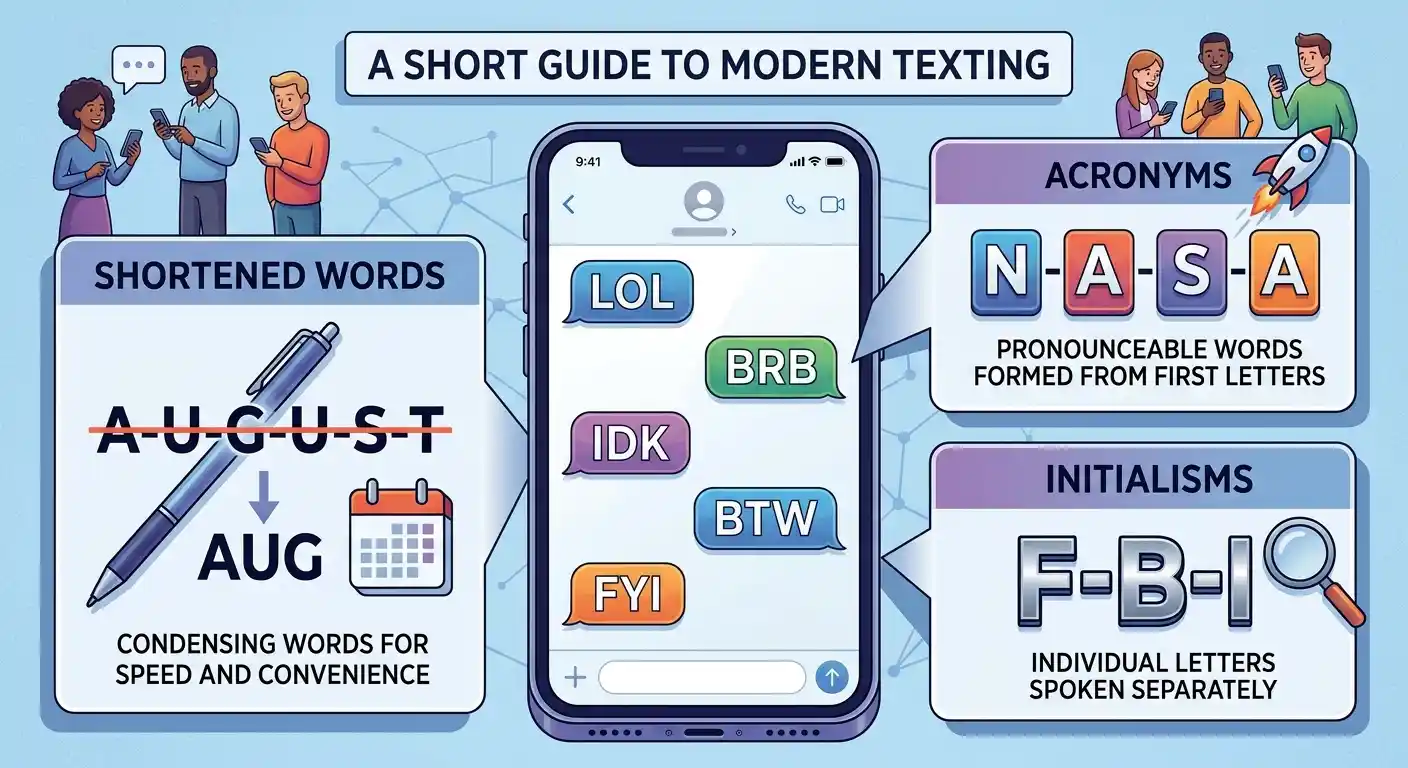
Acronyms and abbreviations are shortened forms of words or phrases used to make communication quicker and easier. An acronym is typically formed from initial letters and pronounced as a word, while “abbreviation” is the broader term for shortened forms. In texting and social media, both are widely used as convenient messaging shorthand.
Key Takeaways
- Abbreviation is the broad category for shortened words or phrases.
- Acronyms are a type of shortened form, usually created from letters or parts of words.
- An acronym is generally pronounced as a word, such as NASA.
- An initialism is pronounced letter by letter, such as HTML or FBI.
- Texting uses many short forms, including LOL, BRB, BTW, IDK, and FYI.
- The meaning of a short form can depend on context, platform, audience, and subject.
Acronyms and Abbreviations Meaning
The terms acronym and abbreviation are closely related, but they are not always interchangeable.
An abbreviation is any shortened version of a word or phrase. For example, “approx.” is an abbreviation of “approximately,” while “Dr.” is an abbreviation of “Doctor.”
An acronym is a more specific type of shortened form. It is commonly created from the initial letters or parts of several words and is pronounced as a word. NASA, for example, is pronounced as one word rather than as separate letters.
In everyday conversation, however, people often use “acronym” as a general label for many shortened forms, including initialisms and texting abbreviations.
What Does Abbreviation Mean?
An abbreviation is a shortened form of a word, phrase, name, or expression.
Examples include:
| Abbreviation | Full Form |
|---|---|
| Mr. | Mister |
| Dr. | Doctor |
| Ave. | Avenue |
| approx. | Approximately |
| etc. | Et cetera |
| Jan. | January |
Abbreviations can appear in everyday writing, academic work, business communication, technical documents, addresses, texting, and social media.
The main purpose is usually saving space, reducing repetition, or making communication more efficient.
What Does Acronym Mean?
An acronym is a shortened form created from the letters or parts of a longer name or phrase and pronounced as a word.
Examples include:
- NASA — National Aeronautics and Space Administration
- NATO — North Atlantic Treaty Organization
- UNESCO — United Nations Educational, Scientific and Cultural Organization
- RADAR — Radio Detection and Ranging
- SCUBA — Self-Contained Underwater Breathing Apparatus
The important feature is pronunciation as a word.
For example, people normally say “NASA” as a word, rather than saying each letter separately.
Acronym vs. Abbreviation
The simplest way to remember the difference is:
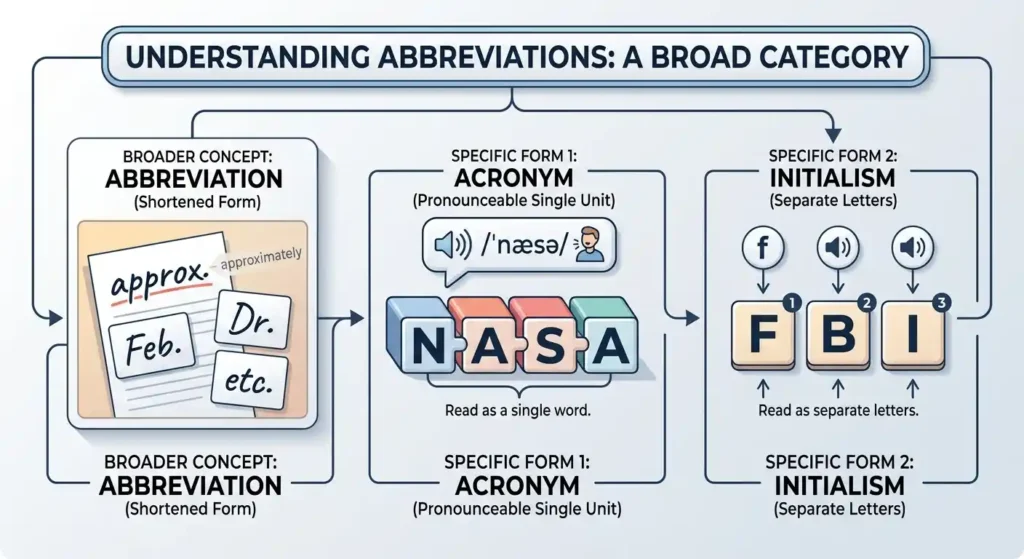
Every acronym is a shortened form, but not every abbreviation is an acronym.
| Term | Meaning | Example |
|---|---|---|
| Abbreviation | Any shortened word or phrase | approx. |
| Acronym | Shortened form pronounced as a word | NASA |
| Initialism | Shortened form pronounced letter by letter | FBI |
| Text abbreviation | Short form used in digital messaging | IDK |
This distinction can become less strict in everyday language. Dictionaries, style guides, organizations, and individual writers may use these terms somewhat differently.
Acronyms vs. Initialisms
Acronyms and initialisms are especially easy to confuse.
An acronym is generally pronounced as a word:
- NASA
- NATO
- UNESCO
- RADAR
An initialism is pronounced one letter at a time:
- FBI
- USA
- HTML
- CEO
Both are shortened forms, but their pronunciation is different. Some shortened forms can also have mixed or disputed classifications, so pronunciation and convention matter.
Acronyms and Abbreviations in Texting
Texting has made shortened communication especially common. People use text abbreviations, internet slang, chat acronyms, and messaging shorthand to communicate quickly in texts, DMs, comments, and group chats.
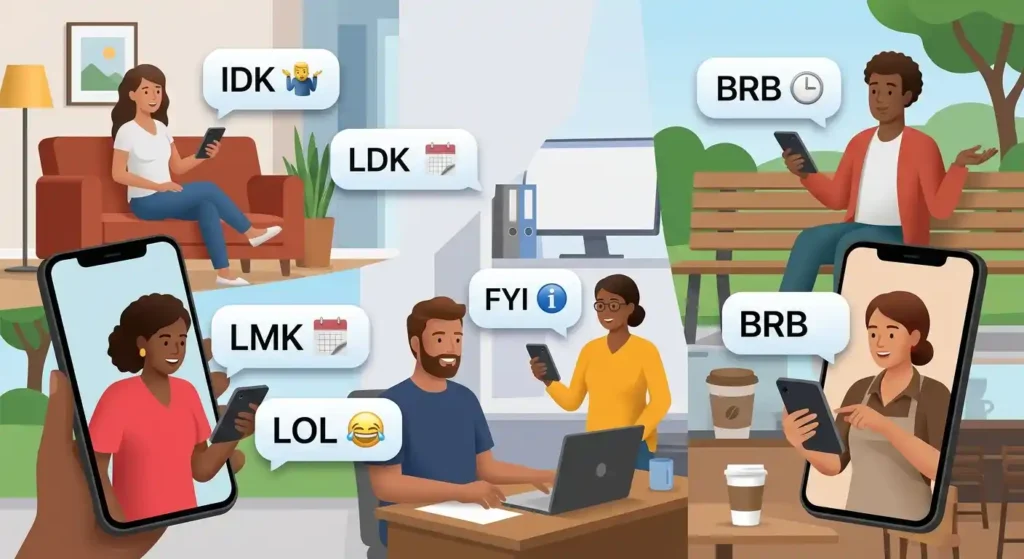
Common examples include:
| Short Form | Meaning | Common Use |
|---|---|---|
| LOL | Laughing Out Loud | Reaction |
| BRB | Be Right Back | Temporary absence |
| BTW | By The Way | Adding information |
| IDK | I Don’t Know | Uncertainty |
| IMO | In My Opinion | Giving an opinion |
| FYI | For Your Information | Sharing information |
| TBH | To Be Honest | Personal opinion |
| LMK | Let Me Know | Asking for a response |
| OMG | Oh My God | Surprise or emphasis |
| JK | Just Kidding | Clarifying a joke |
| IRL | In Real Life | Offline life |
| DM | Direct Message | Private social-media message |
Current online communication resources commonly group these forms under texting, internet slang, social media, and chat terminology.
How Are Acronyms and Abbreviations Used?
Acronyms and abbreviations can appear almost anywhere people communicate.
Text Messages
In texting, short forms can make casual conversations faster.
Example:
“IDK what time we’re leaving.”
Here, IDK replaces “I don’t know.”
Social Media
Social media posts and comments frequently use short forms such as POV, DM, FYP, IRL, IMO, and TBH.
The exact meaning can depend on the platform and surrounding conversation.
Group Chats
Group chats often contain several abbreviations because people are communicating quickly with multiple participants.
“BRB, grabbing food.”
“FYI, the plan changed.”
Online Communities
Forums, gaming communities, and specialized online groups can develop their own abbreviations. A term that is obvious within one community may be confusing outside it.
School and Work
Acronyms are also common in academic, technical, medical, and professional writing. However, unfamiliar abbreviations should generally be explained when readers may not know them. Style guidance recommends defining unfamiliar shortened forms when they first appear.
Real Chat Examples
Here are realistic examples showing how different texting abbreviations work:
- “IDK, maybe tomorrow.” — expressing uncertainty.
- “BRB, my food just arrived.” — saying you will return shortly.
- “BTW, did you finish the assignment?” — adding another question.
- “LOL that was hilarious.” — reacting to something funny.
- “LMK when you get home.” — asking someone to provide an update.
- “FYI, the meeting starts at 3.” — sharing useful information.
- “TBH, I liked the first version better.” — giving an honest opinion.
- “IMO, that movie was great.” — stating an opinion.
- “OMG, I forgot my keys.” — expressing surprise or frustration.
- “JK 😂” — showing that the previous statement was a joke.
- “DM me the details.” — asking for a private message.
- “IRL, he’s actually really quiet.” — referring to offline behavior.
- “ASAP would be great.” — requesting something soon.
- “TMI 😂” — reacting to information that feels overly personal.
- “NP, don’t worry about it.” — saying there is no problem.
- “TY for helping!” — thanking someone.
- “TTYL, I have to go.” — saying you will talk later.
- “NGL, that was impressive.” — introducing an honest opinion.
- “WYD?” — asking what someone is doing.
- “HBD! Hope you have an amazing day.” — wishing someone a happy birthday.
How to Understand an Acronym in Context
When you see an unfamiliar abbreviation, do not automatically assume it has only one meaning.
Look at:
- The words around it
- The topic of the conversation
- The platform where it appears
- Whether it is a text, comment, email, or document
- The relationship between the people communicating
- Capitalization and punctuation
- Emojis or other surrounding clues
For example, DM usually refers to a direct message in a social-media conversation, while another context could give the same letters a completely different meaning.
What Tone Do Acronyms and Abbreviations Have?
A short form does not have one fixed tone.
Depending on the expression and context, it can sound:
- Casual — “BTW, are you coming?”
- Friendly — “TY! 😊”
- Playful — “LOL 😂”
- Neutral — “FYI, the time changed.”
- Informal — “IDK yet.”
- Professional — when a well-known workplace abbreviation is appropriate
- Confusing — when the reader does not recognize the term
The abbreviation itself is only one part of the message. The surrounding words and situation often determine how it feels.
Are Acronyms and Abbreviations Rude?
No. Acronyms and abbreviations are not inherently rude or offensive. Their appropriateness depends on the specific term, audience, and situation.
They are usually comfortable in:
- Casual texts
- DMs
- Group chats
- Social-media comments
- Informal online conversations
More caution is useful in:
- School assignments
- Formal emails
- Job applications
- Professional reports
- Official documents
If your audience may not understand a short form, spelling it out the first time is usually clearer.
Who Uses Acronyms and Abbreviations?
Acronyms and abbreviations are used by people across many types of communication, not one particular age group.
You can find them in:
- Everyday conversation
- Business
- Education
- Technology
- Medicine
- Government
- Sports
- Social media
- Text messaging
- Online communities
Texting slang can be especially informal, but that does not mean every acronym is slang or belongs to a particular generation.
Other Meanings of Acronyms and Abbreviations
The same abbreviation can mean different things in different fields.
For example, AI can mean “artificial intelligence,” while another field may use the same letters for something else. PC can mean “personal computer,” but it can also have other meanings depending on the context.
This is why an acronym dictionary or abbreviation list may show multiple meanings for the same letters.
The correct interpretation comes from context, not simply from the letters themselves.
Acronyms and Abbreviations vs. Slang
Acronyms and slang are not the same thing.
Slang refers to informal language associated with particular social contexts or communities.
An abbreviation simply shortens a word or phrase.
An acronym is a particular kind of shortened form.
For example:
- LOL can function as a texting acronym and informal internet expression.
- NASA is an acronym but is not normally considered texting slang.
- Dr. is an abbreviation but is not internet slang.
- FBI is an initialism rather than an acronym under the pronunciation-based distinction.
This difference matters because not every shortened form is slang.
Common Mistakes About Acronyms and Abbreviations
Calling Every Short Form an Acronym
People often use “acronym” as a general term for all shortened forms. In technical usage, however, acronyms, initialisms, and other abbreviations can be distinguished.
Assuming Every Acronym Is Texting Slang
Many acronyms existed long before social media and texting. Organizations, scientific fields, government agencies, and businesses use them extensively.
Ignoring Context
The same letters can have multiple meanings. Always consider the surrounding conversation.
Using Too Many Unexplained Terms
A message full of unfamiliar abbreviations can become harder to understand rather than easier.
Using Casual Texting Shortcuts in Formal Writing
A short form that works well in a group chat may not be appropriate for an academic paper or formal professional message.
Related Internet Slang and Short Forms
| Term | Meaning | Common Use |
|---|---|---|
| LOL | Laughing Out Loud | Reaction to something funny |
| BRB | Be Right Back | Temporary absence |
| IDK | I Don’t Know | Uncertainty |
| BTW | By The Way | Adding information |
| FYI | For Your Information | Sharing information |
| IMO | In My Opinion | Giving an opinion |
| TBH | To Be Honest | Honest reaction |
| LMK | Let Me Know | Requesting information |
| IRL | In Real Life | Offline situations |
| DM | Direct Message | Private online communication |
Real-World Conversation
Alex: “BTW, are you joining us tonight?”
Sam: “IDK yet. LMK what time you’re leaving.”
Alex: “Around 7. FYI, we’re meeting at the café.”
Sam: “Okay, TY! I’ll let you know.”
In this conversation, the abbreviations make the messages shorter without changing their basic meaning.
People Also Ask
What is the difference between an acronym and an abbreviation?
An abbreviation is a general shortened form of a word or phrase. An acronym is a more specific type of shortened form, commonly formed from letters or parts of words and pronounced as a word.
Is an acronym the same as an initialism?
Not exactly. An acronym is generally pronounced as a word, while an initialism is pronounced as individual letters. For example, NASA is commonly pronounced as a word, while FBI is pronounced letter by letter.
Are texting abbreviations the same as acronyms?
Not always. Texting abbreviations are shortened forms used in digital communication, while an acronym is a particular type of shortened form. Some texting expressions are acronyms, while others are simply shortened words or phrases.
Why do people use abbreviations in texting?
They can make casual messages quicker and more compact. They can also become familiar shorthand within a particular group or online community.
Are abbreviations appropriate in formal writing?
Some are. Well-established abbreviations can be appropriate in professional or academic writing, but unfamiliar ones should generally be explained so readers understand them.
Can one abbreviation have multiple meanings?
Yes. The same letters can represent different words or phrases in different subjects or conversations. Context is often necessary to identify the intended meaning.
What are common examples of texting abbreviations?
Examples include LOL, BRB, IDK, BTW, FYI, IMO, TBH, LMK, and IRL. Their meanings are generally understood from the surrounding conversation.
Is “LOL” an acronym or abbreviation?
In everyday online communication, LOL is commonly described as an acronym or initialism for “laughing out loud.” Because terminology varies, people may use “abbreviation” as the broader label.
Conclusion
Acronyms and abbreviations are shortened forms used to make communication more efficient. Acronyms are generally pronounced as words, while initialisms are spoken letter by letter, and abbreviations cover the broader category of shortened forms. In texting and social media, these shortcuts can make conversations faster, but context and audience determine whether a particular term is clear and appropriate.

For three and a half years, Charlotte Reed has worked as a writer shaping puns and jokes around distinct subjects and vocabulary. She covers food, animals, seasonal themes, technology, entertainment, and trending topics. Her process includes examining topic-specific language, building wordplay from relevant terms, and editing punchlines for sharper phrasing, structure, and comedic timing.