Online community slang refers to informal words, abbreviations, acronyms, phrases, and expressions that develop or become popular within internet communities. It can appear in chats, comments, forums, gaming discussions, social media, and other forms of online communication.
Key Takeaways
- Online community slang is informal language used within internet-based communities.
- It can include abbreviations, acronyms, shortened phrases, memes, and community-specific expressions.
- The meaning of a slang term can depend heavily on the community and conversation context.
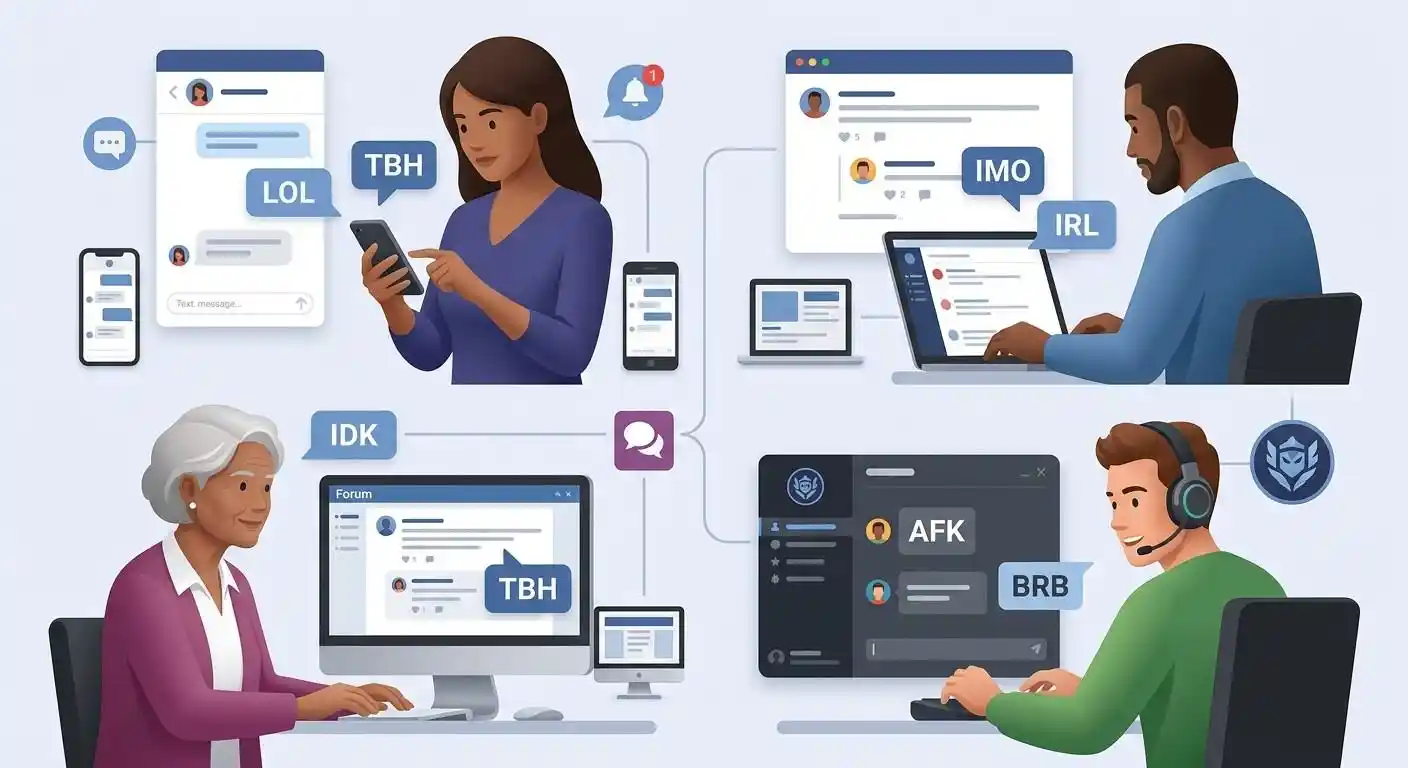
- Common examples include LOL, BRB, IMO, IDK, TBH, and IRL.
- Some terms are widely understood, while others may make sense only to a particular online community.
- Slang is generally better suited to casual online communication than formal or professional writing.
Online Community Slang Meaning
Online community slang is a broad term for informal language used by people communicating online. It is not one specific abbreviation or phrase; instead, it describes a category of language that can develop around internet communities and digital communication.
This can include text slang, internet slang, messaging shorthand, acronyms, initialisms, memes, shortened words, and community-specific expressions.
For example:
- LOL — laughing out loud
- BRB — be right back
- IDK — I don’t know
- TBH — to be honest
- IMO — in my opinion
- IRL — in real life
- AFK — away from keyboard
Some expressions are broadly recognized across the internet, while others have a more limited meaning within a particular community. Context is therefore important when interpreting unfamiliar slang.
What Does Online Community Slang Stand For?
Online community slang does not have one full form. It is a descriptive term for informal language used in online communities.
The word slang refers to informal language, while online community describes the digital setting where that language is used. Individual slang terms can have their own full forms, such as BRB = Be Right Back or IMO = In My Opinion.
So, unlike a traditional acronym, “online community slang” is not something that needs to be expanded into a longer phrase.
How Is Online Community Slang Used?
Online community slang can appear in many types of digital communication.
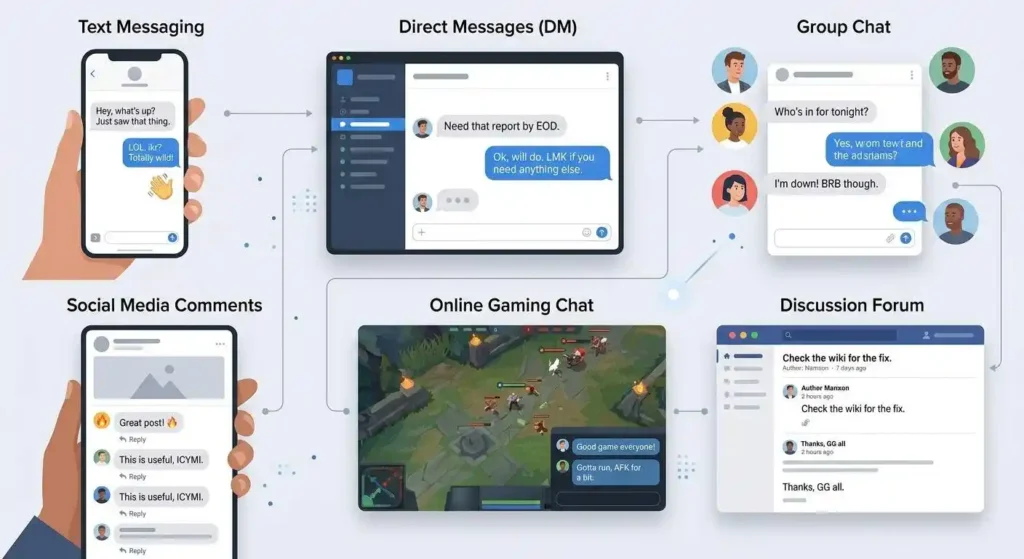
Text Messages
People may use familiar abbreviations to make casual messages shorter or more conversational.
“IDK what time I’ll be home.”
“BRB, grabbing some food.”
DMs
Informal shorthand can also appear in private messages and casual conversations.
“TBH, I didn’t expect that.”
Group Chats
Group conversations often develop their own expressions, inside jokes, and shorthand.
“LOL that was actually hilarious.”
Social Media
Slang can appear in captions, replies, comments, and posts.
“That outfit is fire.”
Gaming Communities
Gaming communities often have specialized vocabulary alongside more general internet slang. A term may have a meaning that makes sense within gaming but not in an ordinary text conversation.
Forums and Online Communities
Discussion communities can develop their own recurring expressions, abbreviations, and references. Understanding the surrounding conversation is often the easiest way to interpret them.
Online Community Slang in Different Contexts
The same expression can feel different depending on who says it, where it appears, and what is being discussed.
From a Friend
A friend may use slang simply to keep the conversation casual.
“LOL you actually did it.”
This does not necessarily carry any deeper meaning.
From a Guy or Girl
The gender of the person using slang does not automatically change its definition. The surrounding conversation matters more than the person’s gender.
From a Crush
If slang appears in a conversation with someone you like, it is easy to wonder whether the wording has a romantic meaning. However, slang alone does not prove flirting or attraction.
Look at the broader conversation, including the wording, punctuation, emojis, and relationship between the people involved.
In Dating
Online slang can make dating conversations feel more casual, but an abbreviation by itself usually does not establish someone’s intentions.
In a Group Chat
Groups may develop shared jokes, abbreviations, or references that outsiders may not understand immediately.
In Social Media Comments
A short slang expression can act as a reaction, compliment, joke, disagreement, or reference. The surrounding post usually provides important clues.
Real Chat Examples
Here are realistic examples showing how different types of online community slang can appear in conversations:
- Friend: “IDK what movie we should watch.”
- Friend: “BRB, my food just got here.”
- Friend: “TBH, I liked the first one better.”
- Friend: “LOL I forgot about that.”
- Friend: “IMO, the second option is better.”
- Friend: “LMK when you get home.”
- Friend: “NVM, I figured it out.”
- Friend: “BTW, are you coming tomorrow?”
- Friend: “ICYMI, they posted the update.”
- Friend: “IRL that place is way bigger.”
- Group chat: “LOL everyone saw that at the same time.”
- Group chat: “IDK who suggested this 😂”
- Comment: “TBH this is really good.”
- Comment: “IMO this deserves more attention.”
- DM: “LMK if you want to join.”
- DM: “BRB, I have to answer the door.”
- Gaming chat: “AFK for a few.”
- Gaming chat: “GG, that was close.”
- Forum: “AFAIK, that feature isn’t available yet.”
- Social media: “ICYMI, here’s the original post.”
These examples show why context matters. The same abbreviation can be understood differently when it appears in a technical community, gaming conversation, social-media comment, or everyday text.
How to Reply to Online Community Slang
Because online community slang covers many different expressions, the best reply depends on the specific term.
Casual Replies
For a straightforward casual message, you can simply respond naturally:
- “Yeah, same.”
- “Haha, exactly.”
- “Gotcha.”
- “Sounds good.”
- “For sure.”
Friendly Replies
If the conversation is friendly, you can match the informal tone:
- “Haha, I know 😂”
- “Exactly!”
- “That makes sense.”
- “Same here!”
Funny Replies
If the original message is clearly joking, a playful response can work:
- “You’re not wrong 😂”
- “Okay, that got me.”
- “I can’t even argue with that.”
Neutral Replies
If you’re unsure what an abbreviation means, there is nothing wrong with asking:
- “What does that mean?”
- “Wait, what does that abbreviation stand for?”
- “I haven’t seen that one before.”
Flirty or Relationship Replies
If the conversation has a romantic context, respond based on the overall conversation, not just the slang term. A slang abbreviation by itself does not establish romantic intent.
What Tone Does Online Community Slang Have?
Online community slang is generally informal and conversational, but its exact tone depends on the expression.
It can be:
- Casual — common in everyday digital conversations
- Friendly — used between people who know each other
- Playful — used for jokes or lighthearted reactions
- Direct — some abbreviations communicate an idea quickly
- Neutral — certain shorthand simply saves typing
- Community-specific — some expressions make sense mainly to members of a particular online group
The surrounding message, punctuation, emojis, and topic can all affect how a slang expression feels.
Is Online Community Slang Rude or Offensive?
Online community slang is not automatically rude or offensive. Most slang is simply informal.
It is generally more appropriate for:
- Casual conversations
- Friends
- Group chats
- Social media
- Informal online communities
For school assignments, professional emails, workplace communication, and formal writing, standard language is usually a safer choice unless the slang is specifically relevant to the subject.
Some individual slang expressions can have offensive meanings, so unfamiliar terms should be interpreted in context rather than assuming every internet abbreviation is harmless or inappropriate.
Other Meanings of Online Community Slang
“Online community slang” is a category rather than a specific acronym, so it does not have separate technology, finance, medical, or sports expansions.
However, community-specific slang can appear in specialized areas such as gaming, technology, fandoms, sports discussions, and social-media communities. In those settings, the same word may have a specialized meaning that differs from ordinary conversation.
For example, AFK is common in gaming and online communication, where it means away from keyboard. Its meaning is closely connected to the context in which people communicate.
Common Mistakes About Online Community Slang
Assuming Every Abbreviation Has One Meaning
Some abbreviations have multiple meanings. Context helps determine which interpretation makes sense.
Treating All Internet Slang as Universal
A term that is familiar in one online community may be unfamiliar somewhere else.
Assuming Slang Proves Romantic Interest
A casual abbreviation does not automatically mean someone is flirting, interested, or rejecting you.
Confusing Slang With Formal Abbreviations
Some short forms are internet slang, while others are technical, professional, or organizational abbreviations.
Ignoring the Conversation
Looking only at the letters can lead to a wrong interpretation. The surrounding sentence and conversation topic often provide the missing clue.
Online Community Slang and Related Slang
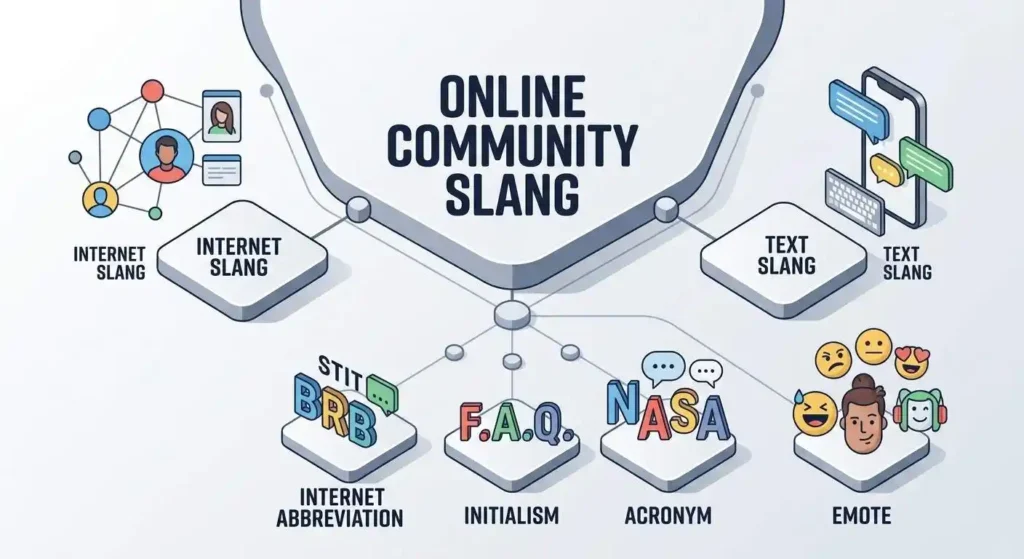
| Term | Meaning | Common Use |
|---|---|---|
| Internet slang | Informal language used online | Social media, chats, forums |
| Text slang | Informal shorthand used in messaging | Texts and DMs |
| Internet abbreviation | A shortened form used in digital communication | Chats and social media |
| Initialism | A shortened phrase pronounced by its individual letters | Online and everyday communication |
| Acronym | A shortened form made from initial letters and commonly pronounced as a word | Online and general communication |
| Emote | A short visual or text-based expression of emotion or reaction | Online communities and gaming |
The important distinction is that online community slang is the broader category. Acronyms, initialisms, abbreviations, and specialized expressions can all be part of it.
People Also Ask About Online Community Slang
What is online community slang?
Online community slang is informal language used by people communicating through internet-based communities. It can include abbreviations, acronyms, shortened phrases, memes, and expressions specific to particular groups.
Why do people use slang online?
Slang can make digital conversations shorter, more casual, expressive, or connected to a particular community. Some shorthand also became common because earlier messaging systems placed greater limits on typing and message length.
What is the difference between internet slang and texting slang?
They overlap, but internet slang is broader. Texting slang focuses specifically on messaging, while internet slang can also appear in social media, forums, gaming communities, comments, and other online spaces.
Is online slang considered proper English?
Online slang is a form of informal language rather than a replacement for standard formal English. Whether it is appropriate depends on the audience, setting, and purpose of the communication.
Why can online slang be difficult to understand?
Some terms are community-specific, have multiple meanings, or change meaning depending on context. An unfamiliar abbreviation may therefore require looking at the entire conversation rather than just the letters.
Can slang have different meanings in different communities?
Yes. A short expression can have one meaning in everyday texting and another meaning in a specialized community. The surrounding topic and community are important clues.
Is internet slang the same as an acronym?
No. An acronym is one type of shortened expression. Internet slang is a much broader category that can include acronyms, initialisms, abbreviations, shortened words, phrases, and other informal expressions.
Conclusion
Online community slang is informal language used across internet-based communication. It includes abbreviations, acronyms, initialisms, shortened phrases, memes, and community-specific expressions.
There is no single full form for the term itself. Its meaning is broad and depends on the online setting, conversation, and community. Because slang is informal, it generally fits casual digital communication better than formal or professional writing.
The safest way to understand unfamiliar online slang is to consider the exact wording, surrounding conversation, community, and context rather than assuming that every abbreviation has one fixed meaning.

Emma Brooks is a writer whose work centers on puns, jokes, and topic-specific wordplay. Across four and a half years of experience, she has covered subjects involving food, animals, seasonal occasions, technology, entertainment, and trending topics. Emma identifies useful terms, tests different joke angles, and revises setups and punchlines to strengthen wording and comedic delivery.