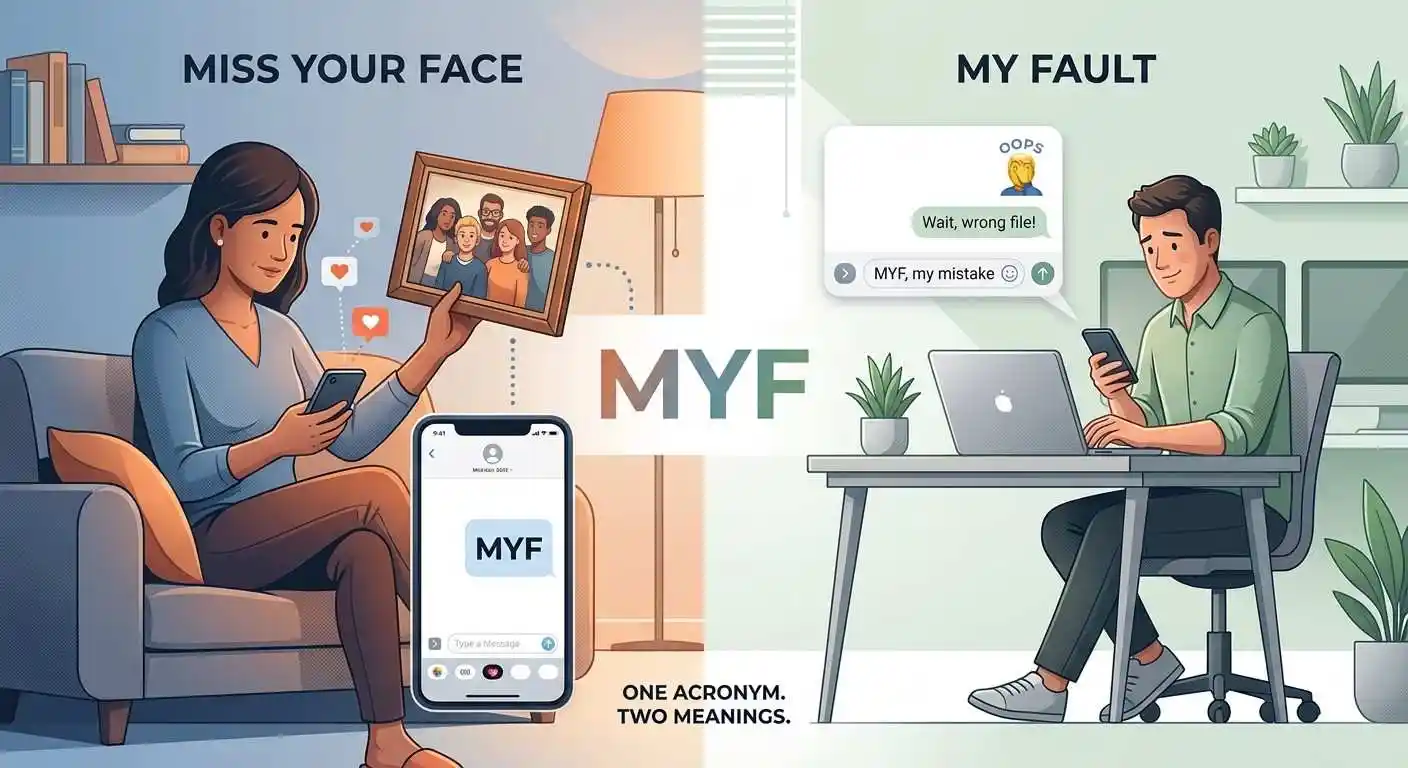
MYF in text can mean “Miss Your Face” or “My Fault,” depending on context. “Miss Your Face” is a warm way to say you miss seeing someone, while “My Fault” is a casual way to admit a mistake. The surrounding message usually reveals which meaning is intended.
Key Takeaways
- MYF does not have one universally fixed texting meaning.
- “Miss Your Face” is used as a warm, affectionate way to say you miss seeing someone.
- “My Fault” can be used as a short, casual apology or admission of responsibility.
- Context is especially important because the two meanings create very different tones.
- MYF is informal and fits casual texts, DMs, and online conversations better than professional writing.
- A message from a friend or crush does not automatically have romantic meaning; the full conversation matters.
MYF Meaning in Text
MYF is an informal texting abbreviation with more than one established interpretation. Two useful meanings to know are “Miss Your Face” and “My Fault.”
When MYF means “Miss Your Face,” it expresses that someone misses seeing another person or spending time with them.
“MYF! We need to hang out soon.”
Here, the sender is saying they miss seeing you.
When MYF means “My Fault,” it is used after a mistake:
“MYF, I forgot to send the picture.”
Here, MYF means “That was my fault.”
Because MYF is less standardized than abbreviations such as LOL or IDK, context is the key to interpreting it correctly. The wording before and after MYF can usually tell you which meaning makes sense.
What Does MYF Stand For?
MYF can stand for different phrases in casual online communication.
MYF = Miss Your Face
In this use:
- M = Miss
- Y = Your
- F = Face
It is a playful, personal way to tell someone that you miss seeing them.
MYF = My Fault
In this use:
- M = My
- F = Fault
The letters are being used as a quick abbreviation for “my fault.”
This version commonly appears when someone acknowledges a mistake:
“MYF, I sent the wrong file.”
The phrase is similar in meaning to “my bad” or “that was my mistake.”
How Is MYF Used?
MYF is mainly found in informal digital communication. It can appear in text messages, DMs, group chats, comments, and other casual online conversations.
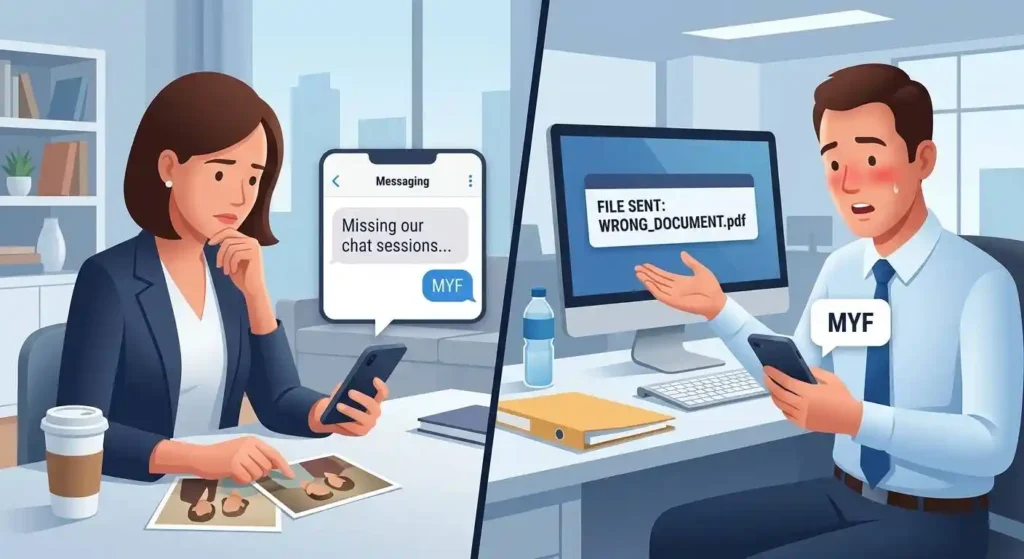
Text Messages
The meaning depends on the sentence.
Affectionate:
“MYF! When are you coming home?”
Apologetic:
“MYF, I forgot about our plans.”
Direct Messages
A person may use “Miss Your Face” when talking to someone they have not seen recently.
“That old picture reminded me of you. MYF.”
Or they may use “My Fault” after making a small mistake.
“MYF, I thought you already knew.”
Group Chats
“My Fault” can work as a quick acknowledgment:
“MYF, I sent the wrong address.”
“Miss Your Face” can also appear when someone is talking about a friend who is away:
“MYF! Come visit us soon.”
Social Media
MYF can appear in casual comments, replies, captions, or DMs. However, the surrounding words are more reliable than the platform itself for identifying the intended meaning.
Gaming Chats
In a gaming conversation involving a mistake, “My Fault” can make sense:
“MYF, I missed the call.”
If the conversation is about missing someone, “Miss Your Face” may fit instead.
MYF in Different Contexts
MYF is a good example of why context matters more than the three letters themselves.
From a Friend
If a friend says:
“Haven’t seen you all week. MYF.”
“Miss Your Face” makes sense.
If they say:
“MYF, I forgot to text you back.”
“My Fault” is clearly more likely.
From a Guy
If a guy sends MYF, the abbreviation itself does not automatically create a romantic meaning.
“MYF, we haven’t hung out in forever.”
This could simply be a friendly message.
From a Girl
The same principle applies if a girl uses MYF. The sender’s gender does not determine the meaning.
Look at the surrounding conversation to decide whether MYF means “Miss Your Face” or “My Fault.”
From a Crush
If a crush sends:
“MYF ❤️”
the context may make “Miss Your Face” a reasonable interpretation.
However, MYF alone does not prove romantic interest. The overall conversation, relationship, and wording matter more.
In Dating or a Relationship
“Miss Your Face” can naturally appear between people who care about each other:
“Long week. MYF.”
The phrase can sound affectionate without automatically indicating a particular level of romantic interest.
In a Group Chat
“My Fault” is especially easy to recognize when MYF follows a mistake:
“MYF everyone, I sent the wrong time.”
In this situation, the apology context makes the intended meaning clear.
Real Chat Examples
MYF = “Miss Your Face”
1.
Alex: Haven’t seen you in forever. MYF!
Sam: Same! We need to hang out.
2.
Mia: That throwback made me miss you. MYF ❤️
Taylor: Aww, miss you too!
3.
Chris: MYF, when are you coming back?
Jordan: Next weekend!
4.
Alex: School feels different without you. MYF.
Jamie: I’ll be back soon 😂
5.
Maya: MYF! We need another coffee day.
Chris: Absolutely.
6.
Sam: Just saw our old photos. MYF.
Riley: Those were such good times.
7.
Alex: Haven’t talked in ages. MYF!
Jordan: We should catch up.
8.
Mia: MYF already 😭
Jay: It’s only been two days!
9.
Taylor: MYF. Come visit soon!
Chris: I’ll try!
10.
Maya: That picture reminded me of you. MYF.
Sam: That’s sweet.
MYF = “My Fault”
11.
Alex: You sent me the wrong address.
Jordan: MYF, I copied the old one.
12.
Mia: You forgot the tickets.
Jay: MYF 😭 I thought you had them.
13.
Chris: Why did you send that message to the group?
Sam: MYF, wrong chat.
14.
Taylor: You missed my call.
Maya: MYF, my phone was on silent.
15.
Alex: You said we were meeting at 6.
Jamie: MYF, I read your message wrong.
16.
Chris: The link doesn’t work.
Sam: MYF, I sent the old one.
17.
Mia: You forgot to bring the book.
Jay: MYF. I’ll bring it tomorrow.
18.
Alex: We were waiting for you.
Jordan: MYF, I misunderstood the time.
19.
Taylor: That’s not the file I needed.
Chris: MYF, I’ll send the right one.
20.
Maya: You replied to the wrong person.
Sam: MYF 😂
These examples show why the sentence around MYF matters. A message about missing someone points toward “Miss Your Face,” while a message about a mistake points toward “My Fault.”
How to Reply to MYF
Your reply should match the meaning you think the sender intended.
Casual Replies
If MYF means “Miss Your Face”:
- “Miss you too!”
- “Same here!”
- “We need to hang out soon.”
- “It’s been way too long.”
- “Definitely! Let’s catch up.”
If MYF means “My Fault”:
- “No worries.”
- “It’s all good.”
- “You’re fine.”
- “No problem!”
- “Don’t worry about it.”
Friendly Replies
For “Miss Your Face”:
- “Aww, miss you too 😊”
- “I was just thinking about you!”
- “Same! We should meet up.”
- “Come visit soon!”
For “My Fault”:
- “No worries!”
- “It happens.”
- “All good.”
- “You’re okay.”
Funny Replies
If MYF means “Miss Your Face”:
- “Wow, my face has that effect? 😂”
- “Your favorite face, obviously.”
- “Then come say hi 😂”
If it means “My Fault”:
- “Accepted 😂”
- “I’ll let it slide this time.”
- “Case closed!”
Neutral Replies
If you’re unsure which meaning was intended, you can simply ask:
- “Do you mean ‘Miss Your Face’?”
- “You mean my fault?”
- “What do you mean by MYF here?”
A quick clarification is better than guessing when the context is unclear.
Flirty/Relationship Replies
Only use a flirty response when the existing conversation is clearly romantic.
If MYF means “Miss Your Face,” possible replies include:
- “Miss seeing you too 😊”
- “Maybe we should fix that.”
- “I was thinking the same thing.”
MYF by itself does not establish romantic intent, so avoid reading too much into the abbreviation alone.
What Tone Does MYF Have?
MYF has different tones depending on which meaning is intended.
When It Means “Miss Your Face”
The tone is usually:
- Warm
- Friendly
- Affectionate
- Playful
- Personal
- Sometimes romantic, depending on the relationship
When It Means “My Fault”
The tone is usually:
- Casual
- Apologetic
- Direct
- Informal
- Sometimes playful
For example:
“MYF, I forgot.”
sounds like a quick admission of responsibility.
Meanwhile:
“MYF! Haven’t seen you in forever.”
sounds affectionate.
So if you’re trying to understand MYF, the tone of the entire message is more useful than capitalization alone.
Is MYF Rude or Offensive?
MYF is not inherently rude or offensive, but its appropriateness depends on what it means and where you use it.
Casual Conversations
MYF can work naturally with friends and people you regularly chat with.
Social Media
It can fit informal comments, replies, and DMs when the context is clear.
School
It may be fine in a casual message to a friend, but avoid it when submitting formal school work.
Work and Professional Communication
MYF is generally too ambiguous and informal for professional communication.
Instead of:
“MYF.”
write:
“My fault—I sent the wrong file.”
Or, if you mean the affectionate phrase, spell it out clearly rather than relying on an abbreviation that could be misunderstood.
Formal Writing
Avoid MYF in formal writing. Since it can have multiple interpretations, spelling out the intended phrase is clearer.
Other Meanings of MYF
MYF has several context-dependent uses online, but the two most useful texting interpretations are “Miss Your Face” and “My Fault.”
Some slang references also list other expansions, but they are less consistent across sources and communities. Because MYF is not a highly standardized abbreviation, it is better to rely on the actual conversation than to assume an obscure definition.
Common Mistakes About MYF
Assuming MYF Has Only One Meaning
Unlike highly standardized abbreviations, MYF can represent different phrases.
If someone writes:
“MYF, I forgot.”
“My Fault” makes sense.
If they write:
“MYF! Come home soon.”
“Miss Your Face” makes much more sense.
Confusing MYF With “My Friend”
Some online references use MYF as shorthand for “My Friend,” but this interpretation is less consistent than the two main context-based meanings above. If it appears directly before someone’s name, the intended meaning may be clearer from the sentence.
Assuming MYF Is Automatically Flirty
“Miss Your Face” can sound affectionate, but that does not automatically mean romantic interest.
Friends and family can use affectionate language too.
Assuming MYF Always Means “Miss Your Face”
If MYF appears immediately after a mistake, “My Fault” is much more likely.
Treating Every Online Definition as Universal
Internet slang can vary between communities. A meaning found in one group may not be the meaning intended by another person.
When in doubt, read the whole message before deciding what MYF means.
MYF and Related Slang
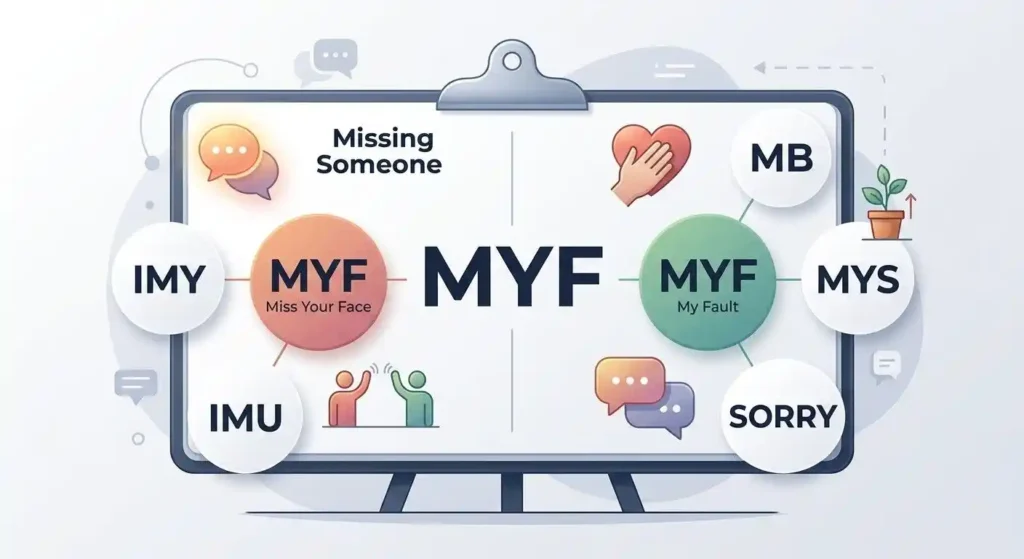
| Term | Meaning | Common Use |
|---|---|---|
| MYF | Miss Your Face / My Fault | Missing someone or admitting a mistake |
| IMY | I Miss You | Directly saying someone is missed |
| IMU | I Miss You | Expressing that someone is missed |
| MB | My Bad | Casual apology |
| MYS | Miss You So | Informal expression of missing someone |
| SORRY | Sorry | Apologizing directly |
The most useful distinction is between MYF and IMY when the context is affectionate:
- MYF = “Miss Your Face”
- IMY = “I Miss You”
MYF sounds a little more playful because it specifically refers to missing someone’s face or presence.
When MYF means “My Fault,” the closest everyday expressions are “my bad,” “my mistake,” and “sorry.”
People Also Ask About MYF
What does MYF mean from a girl?
MYF can mean “Miss Your Face” or “My Fault” when sent by a girl. Her gender does not determine the definition; the surrounding message tells you which interpretation fits.
What does MYF mean from a guy?
It can have the same two meanings: “Miss Your Face” or “My Fault.” If the conversation is about missing someone, the first meaning may fit; if it follows a mistake, the second is more likely.
Does MYF mean “I miss you”?
When MYF means “Miss Your Face,” it communicates a similar idea to “I miss you,” but with a more playful focus on missing someone’s presence or seeing them.
Is MYF a romantic abbreviation?
Not necessarily. “Miss Your Face” can be affectionate or romantic, but friends and family can use it too. The abbreviation alone cannot establish romantic interest.
What does MYF mean after an apology?
If MYF appears after someone makes a mistake, it can mean “My Fault.” For example, “MYF, I forgot to call” means “My fault, I forgot to call.”
Is MYF the same as IMY?
No. IMY means “I Miss You,” while MYF can mean “Miss Your Face” or “My Fault.” The correct interpretation of MYF depends on the surrounding conversation.
Can MYF mean “My Friend”?
Some online users use MYF as shorthand for “My Friend,” but this meaning is not consistent enough to assume automatically. Look at how MYF is positioned in the sentence before deciding.
What should I do if I don’t know which MYF meaning someone intended?
Look at the words around MYF. If the message discusses missing someone, “Miss Your Face” is a natural fit; if it discusses a mistake, “My Fault” is more likely. If neither makes sense, simply ask the sender what they meant.
Conclusion
MYF is a context-dependent texting abbreviation that can mean “Miss Your Face” or “My Fault.” “Miss Your Face” is a warm way to say you miss seeing someone, while “My Fault” is a casual way to accept responsibility for a mistake.
MYF works best in informal texts, DMs, group chats, and casual online communication. Its tone can be affectionate, friendly, apologetic, playful, or direct depending on the meaning.
If MYF appears in a conversation about missing someone, think “Miss Your Face.” If it follows a mistake or correction, think “My Fault.” When the context is unclear, asking the sender is the safest way to avoid misunderstanding.

For three and a half years, Charlotte Reed has worked as a writer shaping puns and jokes around distinct subjects and vocabulary. She covers food, animals, seasonal themes, technology, entertainment, and trending topics. Her process includes examining topic-specific language, building wordplay from relevant terms, and editing punchlines for sharper phrasing, structure, and comedic timing.