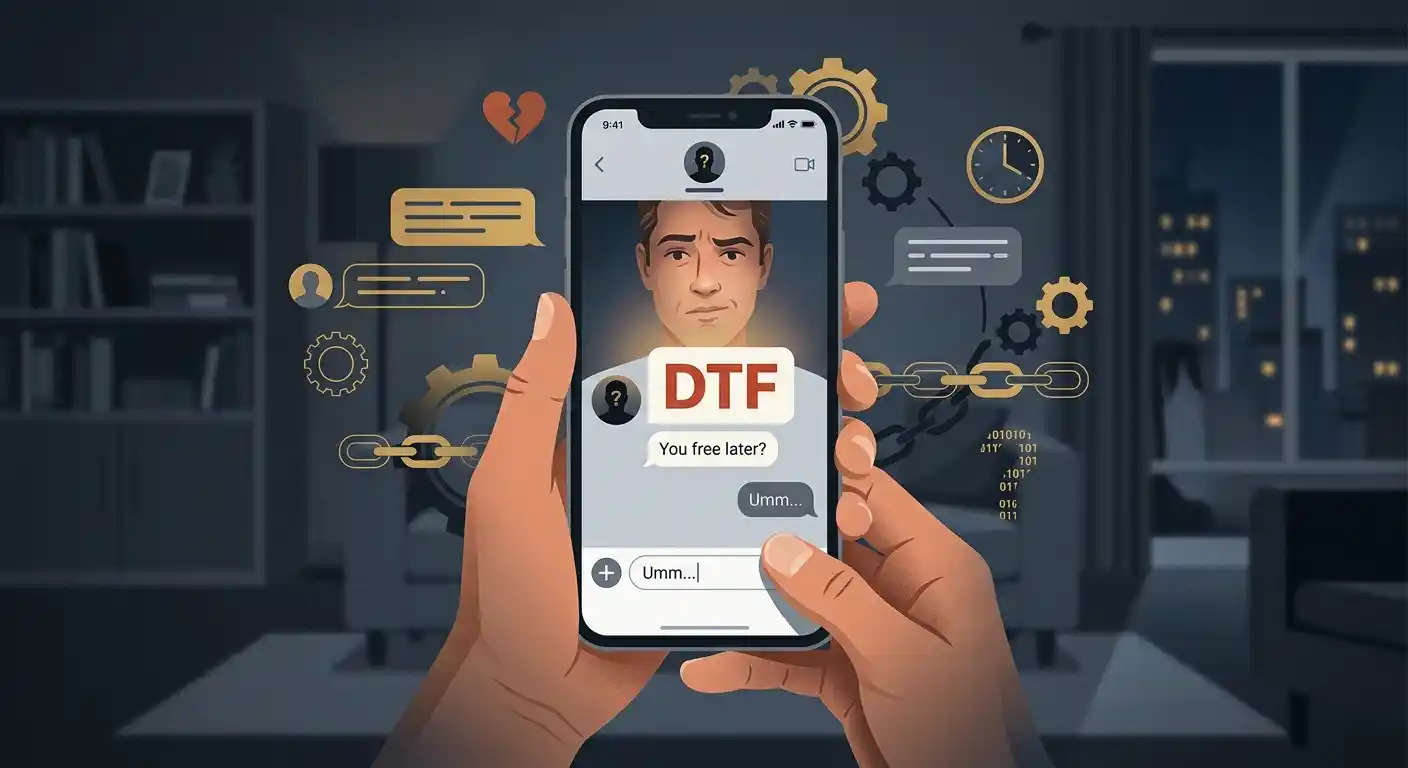
DTF in text usually means “down to fuck,” an explicit slang phrase asking or stating whether someone is willing to have sex or a casual sexual encounter. It is informal, adult language commonly associated with dating, flirting, and private online conversations.
Key Takeaways
- DTF stands for “down to fuck.”
- In texting, it usually refers to sexual willingness or interest.
- It is an initialism and adult internet slang term, not formal language.
- The abbreviation can sound blunt, direct, flirtatious, vulgar, or inappropriate, depending on context.
- DTF does not automatically mean dating, love, commitment, or a specific type of relationship.
- In technical contexts, DTF can have completely different meanings, such as Direct-to-Film in printing.
DTF Meaning in Text
In texting, DTF is an abbreviation for “down to fuck.” In simple terms, it means someone is asking whether another person is willing or interested in having sex, usually in a casual context.
The expression comes from the informal phrase “I’m down to…”, where “down to” means willing or interested in doing something. DTF applies that phrase to sexual activity.
It is considered explicit and vulgar slang, so the meaning is much stronger than simply asking someone if they want to hang out or go on a date.
What Type of Term Is DTF?
DTF is an initialism because the letters represent the beginning of the words in the phrase. People normally pronounce it as “dee-tee-eff.”
You may see it written as:
- DTF
- dtf
- DTF?
- “Are you DTF?”
- “I’m DTF.”
Capitalization does not normally change the meaning.
What Does DTF Stand For?
DTF stands for “Down To Fuck.” It is an adult slang expression used to communicate willingness or interest in having sex, particularly in casual dating or hookup contexts.
Because the final word is profanity, people sometimes write the phrase in softened forms such as “Down to F*”** or “Down to F.” The abbreviation still carries the same underlying meaning.
How Is DTF Used?
DTF can appear in informal digital communication, especially when the conversation involves dating, sexual interest, or hookups.
Text Messages
Someone might write:
“Are you DTF tonight?”
Here, the person is directly asking about sexual interest.
Dating Conversations
A person may use DTF to communicate that they are interested in something physical rather than simply looking for a traditional date.
DMs
In private messages, DTF may be used as a direct question, statement, joke, or flirtatious comment.
Group Chats and Memes
Friends may sometimes use DTF jokingly because the abbreviation has a well-known adult meaning. In those cases, the sender may not be making a literal sexual proposition.
Context matters more than the three letters alone.
DTF in Different Contexts
From a Friend
If a friend sends DTF during an unrelated conversation, it may be a joke or reference to the slang rather than a serious proposition.
For example:
“Everyone canceled the party. DTF to just order pizza? 😂”
Here, the surrounding wording makes the intended meaning different from the standard sexual interpretation.
From a Guy
If a guy sends “DTF?” during a dating or flirtatious conversation, the usual slang meaning is a direct question about sexual interest.
The fact that the sender is a guy does not create a different definition.
From a Girl
The meaning is the same if a girl uses DTF. The abbreviation itself is not gender-specific.
From a Crush
If a crush sends DTF, the message indicates sexual interest or willingness in that context. However, DTF alone does not prove romantic feelings, love, or an intention to start a relationship.
In Dating
DTF can signal that someone is interested in a sexual or casual encounter. It does not automatically tell you whether they also want dating, exclusivity, or a long-term relationship.
In a Relationship
Partners might use DTF jokingly, flirtatiously, or literally. The meaning depends on the couple’s existing communication style.
In Social Media Comments
DTF can appear as a joke, meme reference, or sexually suggestive comment. A comment using the term does not necessarily represent a serious invitation.
Real Chat Examples
Here are realistic examples showing how DTF can appear in conversation:
- “Are you DTF tonight?”
→ A direct question about sexual interest. - “He asked if I was DTF.”
→ Someone is reporting that another person asked about sexual willingness. - “I’m not DTF, honestly.”
→ A direct rejection of the sexual proposition. - “She said she was DTF.”
→ She indicated sexual willingness in that context. - “DTF?”
→ A very short and blunt sexual question. - “I’m DTF, but I’m not looking for anything serious.”
→ The person is expressing sexual interest while clarifying relationship expectations. - “Are you DTF or just looking for a date?”
→ The sender is distinguishing sexual interest from ordinary dating. - “That DTF message came out of nowhere.”
→ The recipient was surprised by the sexual message. - “He was definitely DTF, but I wanted something more.”
→ The two people had different expectations. - “Sorry, I’m not DTF.”
→ A straightforward refusal. - “Why did you ask me if I’m DTF?”
→ The recipient wants clarification. - “DTF? 😂”
→ The emoji may make the message feel more playful, although the underlying slang remains sexual. - “I thought we were just hanging out. I didn’t realize you were asking if I was DTF.”
→ The recipient misunderstood the sender’s intention. - “Not DTF, but I’d be down to grab coffee.”
→ The person declines the sexual suggestion while offering a social alternative. - “He put ‘DTF’ in his dating profile.”
→ The profile communicates interest in casual sexual encounters. - “That comment was way too DTF for a public post.”
→ The speaker considers the comment overly sexual. - “I’m not comfortable with that kind of DTF talk.”
→ The person sets a boundary. - “We were joking around and someone dropped ‘DTF’ in the group chat.”
→ The term was used humorously. - “If you’re DTF, just be honest about what you want.”
→ The sender is asking for clear intentions. - “I’m not DTF, and I’d rather keep things friendly.”
→ The speaker clearly declines and establishes a boundary.
How to Reply to DTF
Your response should depend on what you actually want and how comfortable you are with the conversation. You do not have to accept, explain yourself, or continue the conversation.
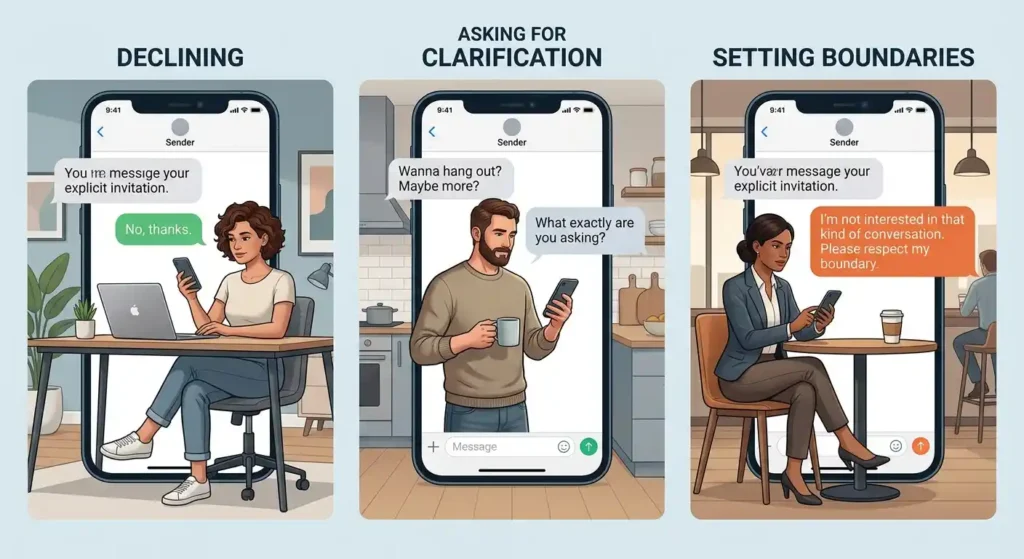
Casual Replies
- “Not really.”
- “No, I’m good.”
- “Nah, not my thing.”
- “I’m just here to hang out.”
- “Not what I’m looking for.”
Friendly Replies
- “I’d rather keep things friendly.”
- “I’m not interested in that, but no hard feelings.”
- “I’m cool with talking, just not that.”
- “I’d rather get to know you first.”
Funny Replies
- “That escalated quickly 😂”
- “Straight to the point, huh?”
- “Well, that’s one way to ask.”
- “You skipped several chapters there 😂”
Neutral Replies
- “What exactly are you asking?”
- “I’m not interested.”
- “No, thanks.”
- “I’d rather not.”
- “I’m looking for something different.”
Flirty/Relationship Replies
If you are an adult and genuinely interested, you can keep the response clear without assuming what the other person wants:
- “I’m interested, but I want to talk about expectations first.”
- “Possibly, but I’d like to get to know you better.”
- “I’m attracted to you, but I want to take things at my own pace.”
A DTF message is not automatic consent to any particular activity, person, place, or time. Either person can change their mind or set boundaries.
What Tone Does DTF Have?
DTF is generally direct, sexually explicit, informal, and blunt.
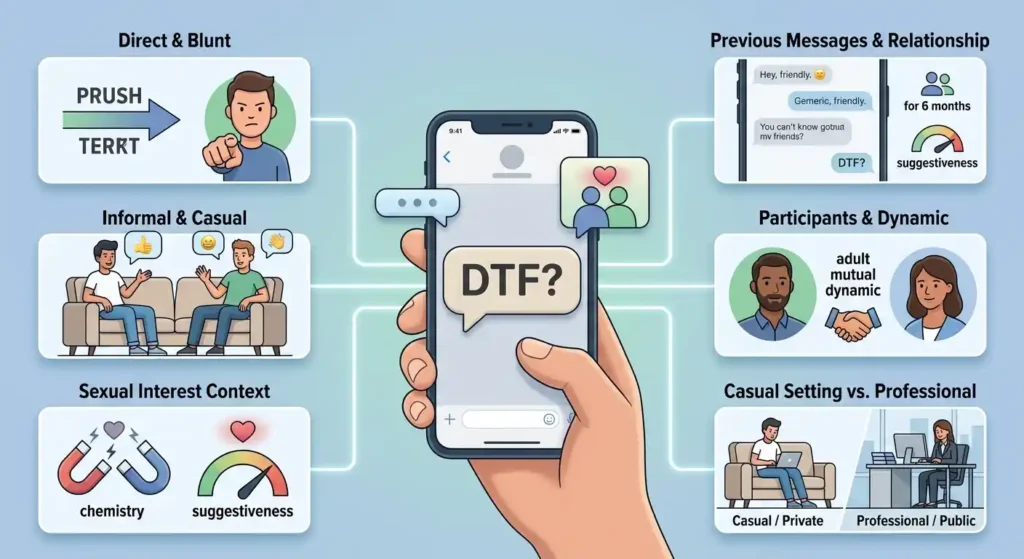
Depending on the conversation, it can feel:
- Direct
- Sexual
- Flirtatious
- Bold
- Casual
- Playful
- Vulgar
- Crude
- Intrusive
For example, “Want to get dinner sometime?” is a general social or dating invitation. “Are you DTF?” is much more sexually direct.
The same abbreviation can therefore feel very different depending on who sends it, what was said before it, and whether sexual conversation was already welcome.
Is DTF Rude or Offensive?
DTF contains profanity and has an explicit sexual meaning, so it is not appropriate for formal or professional communication. Dictionaries classify it as offensive or vulgar slang.
Between consenting adults who are already comfortable discussing sex, it may simply be blunt slang. But if a stranger sends it unexpectedly, it can come across as crude, disrespectful, or unwelcome.
Casual Conversations
DTF may be used among adults who are comfortable with explicit language.
Social Media
It can appear in jokes, memes, comments, or private messages, but the public nature of a platform can make an explicit message inappropriate for its audience.
School or Work
DTF should generally be avoided in school assignments, workplace messages, professional emails, and other formal communication.
Formal Writing
Do not use DTF as casual slang in professional or academic writing. If discussing the term itself, spelling out its meaning may be appropriate when necessary for explanation.
Other Meanings of DTF
The sexual slang meaning is dominant when DTF appears in an ordinary dating or texting conversation. However, DTF also has legitimate technical meanings in specialized contexts.
DTF in Technology and Printing
In printing, DTF means “Direct-to-Film.” It refers to a printing method in which a design is printed onto transfer film and then transferred onto fabric. This meaning has nothing to do with the slang expression.
If the conversation mentions:
- T-shirts
- Hoodies
- Apparel
- Heat transfers
- Printers
- Fabric
- Garment printing
then Direct-to-Film is likely the intended meaning.
DTF in Science
DTF can also refer to deuterium-tritium fusion, a scientific term associated with fusion research.
This meaning would normally appear in a scientific or technical discussion, not an ordinary text message.
DTF in Gaming
Some gaming communities use DTF to mean “down to fight.” This is a context-specific interpretation rather than the standard texting meaning.
For example:
“You DTF?”
In a fighting-game or competitive gaming conversation, the surrounding discussion could make “down to fight” clear.
Common Mistakes About DTF
Assuming DTF Always Means Dating
DTF is about sexual willingness, not necessarily dating. Someone can be interested in sex without asking for a romantic relationship.
Assuming DTF Means Love
DTF does not mean someone is in love or wants a serious relationship.
Assuming DTF Means Consent to Everything
Saying or asking about being DTF does not establish consent to every activity or situation. Specific boundaries still matter.
Assuming Gender Changes the Meaning
DTF means the same thing whether the sender or recipient is a man, woman, or another gender.
Using It in Professional Messages
Because DTF is explicit slang, using it in workplace or formal communication can create unnecessary confusion or discomfort.
Confusing Slang With Printing Terminology
If you see DTF alongside terms such as shirts, fabric, transfers, or printers, it may mean Direct-to-Film, not the sexual slang.
DTF and Related Slang
| Term | Meaning | Common Use |
| DTF | Down to fuck | Direct sexual interest |
| FWB | Friends with benefits | Ongoing friendship with a sexual component |
| ONS | One-night stand | A one-time sexual encounter |
| NSA | No strings attached | Casual relationship without expected commitment |
| HMU | Hit me up | Asking someone to contact you |
| LTR | Long-term relationship | A serious or lasting relationship |
These terms overlap in dating conversations, but they are not interchangeable. DTF specifically communicates sexual willingness, while FWB, ONS, NSA, and LTR describe different relationship arrangements or goals.
People Also Ask About DTF Meaning in Text
What does DTF mean in a text message?
DTF usually means “down to fuck.” It is explicit slang for being willing or interested in having sex, often in a casual context.
Is DTF always sexual?
In ordinary texting and dating contexts, DTF is normally understood sexually. In specialized settings, however, it can have unrelated meanings such as Direct-to-Film printing.
Does DTF mean dating or love?
No. DTF communicates sexual interest or willingness. It does not by itself establish romantic feelings, commitment, or a desire for a long-term relationship.
Is DTF rude?
It can be. The phrase is vulgar and sexually explicit, so an unexpected DTF message from a stranger or in a formal setting may feel crude or inappropriate.
What does DTF mean on social media?
On social media, DTF generally keeps its adult sexual meaning, although people may also use it jokingly or as a meme reference. The surrounding post or conversation helps determine whether it is meant literally.
Does DTF mean the same thing for guys and girls?
Yes. The slang definition does not change based on gender. What changes is the context and the sender’s personal intention.
What is the difference between DTF and FWB?
DTF expresses willingness or interest in sex. FWB, or “friends with benefits,” usually describes an ongoing arrangement involving friendship and sexual activity, so the two terms are related but not identical.
What should I say if someone texts me DTF?
If you are not interested, a simple response such as “No, thanks” or “I’m not interested” is enough. You can also ignore the message or set a clearer boundary if the situation makes you uncomfortable.
Conclusion
DTF in text means “down to fuck,” an explicit and informal way of expressing or asking about sexual willingness. It is most relevant in adult dating, flirting, private messages, and casual online conversations. Its tone can be direct, flirtatious, playful, vulgar, or unwelcome depending on the context. DTF does not automatically mean love, dating, commitment, or consent to a particular activity. In technical conversations, especially printing, DTF can instead mean Direct-to-Film.

For three and a half years, Charlotte Reed has worked as a writer shaping puns and jokes around distinct subjects and vocabulary. She covers food, animals, seasonal themes, technology, entertainment, and trending topics. Her process includes examining topic-specific language, building wordplay from relevant terms, and editing punchlines for sharper phrasing, structure, and comedic timing.