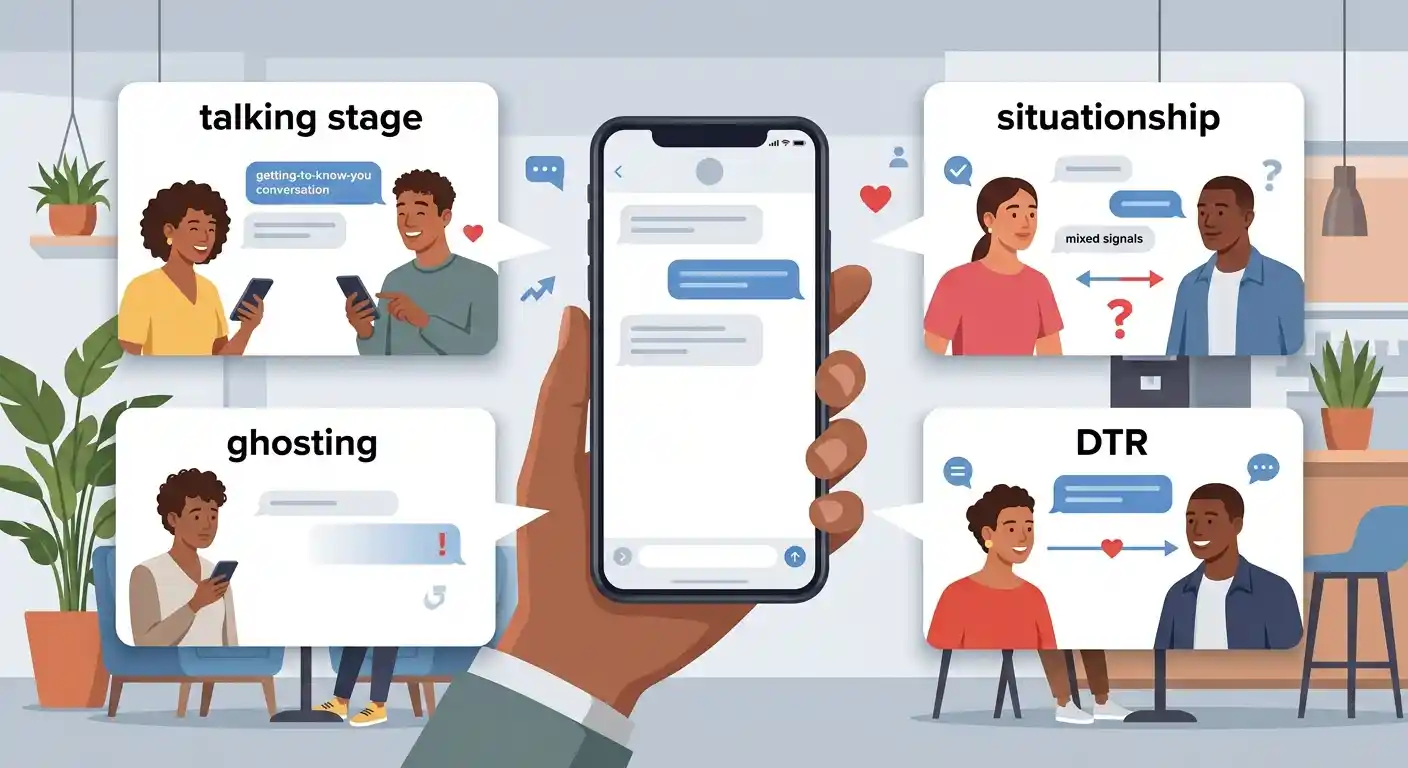
Dating slang refers to informal words and phrases used to describe dating, attraction, relationship stages, communication patterns, and behaviors. Terms such as ghosting, breadcrumbing, situationship, talking stage, and soft launch are commonly used in online dating conversations.
Key Takeaways
- Dating slang is a broad category, not one specific abbreviation or phrase.
- Some terms describe relationship stages, while others describe communication or dating behavior.
- Common examples include talking stage, situationship, ghosting, breadcrumbing, DTR, and soft launch.
- Meanings can vary by context, community, and how people use the term.
- Dating slang can describe what happened without proving why someone behaved that way.
- A slang label alone does not establish someone’s feelings or intentions.
Dating Slang Meaning in Text
Dating slang is informal language used when talking about dating and relationships, especially in texts, DMs, social media, dating-app conversations, and casual discussions.
Unlike a traditional acronym, dating slang is a category of vocabulary. It includes words, phrases, abbreviations, and expressions that describe experiences such as getting to know someone, becoming exclusive, losing interest, or ending communication.
Examples include:
- Talking stage — an early period of getting to know someone before defining the relationship.
- Situationship — a romantic or sexual connection that remains undefined.
- Ghosting — suddenly stopping communication without an explanation.
- Breadcrumbing — giving intermittent attention without progressing the connection.
- DTR — “define the relationship,” referring to a conversation about relationship status or expectations.
- Soft launch — subtly revealing a relationship on social media without fully identifying the person.
The exact meaning should always be interpreted from the surrounding conversation.
What Does Dating Slang Stand For?
Dating slang does not have one full form. It is a general term for informal vocabulary associated with dating and relationships.
Some individual dating terms do have expansions. For example:
- DTR = Define the Relationship
- FWB = Friends With Benefits
- LTR = Long-Term Relationship
Other terms, such as ghosting, breadcrumbing, situationship, and orbiting, are ordinary words or blends rather than acronyms.
How Is Dating Slang Used?
Dating slang can appear in several forms of casual communication.
Text Messages
Someone might say:
“We’re still in the talking stage.”
DMs
A person might describe someone who suddenly stopped replying as:
“He ghosted me.”
Group Chats
Friends may use dating terms while discussing someone’s situation:
“Is this a situationship or an actual relationship?”
Social Media
Terms such as soft launch, orbiting, and breadcrumbing can describe behavior involving posts, stories, likes, or messages.
Dating Slang in Different Contexts
Context is especially important with dating slang. The same behavior can sometimes receive different labels depending on the details.
From a Friend
A friend might say:
“I think I’m being breadcrumbed.”
They are using the term to describe a communication pattern, not necessarily proving the other person’s intentions.
From a Guy or Girl
The basic meaning of a dating term does not change simply because the person using it is a guy or a girl.
From a Crush
If someone says:
“We’re still in the talking stage.”
that describes the current stage of the connection. It does not by itself prove how strongly either person feels.
In Dating
Terms such as ghosting, benching, breadcrumbing, and situationship can describe different dating experiences. The actual behavior and conversation provide the important context.
In a Relationship
Some terms describe established relationships rather than early dating. For example, stonewalling refers to withdrawing or becoming distant during conflict, while roommate syndrome describes a relationship that starts feeling more platonic after living together.
On Social Media
Soft launch describes subtly revealing a relationship online, while orbiting can describe continuing to watch or interact with someone’s social-media activity after direct communication has stopped.
Common Dating Slang Examples
Here are examples of how these terms can appear naturally:
- “We’re definitely still in the talking stage.”
- “I think I got ghosted after the date.”
- “He keeps sending random messages. Is that breadcrumbing?”
- “We talk every day, but we’re not officially together. It’s a situationship.”
- “We should probably DTR at some point.”
- “She posted his hand but didn’t show his face. That’s a soft launch.”
- “He stopped texting but still watches every story. Sounds like orbiting.”
- “They’ve been dating for months, but he hasn’t introduced her to his friends. She thinks she’s being stashed.”
- “They started talking again after disappearing for months. That sounds like zombieing.”
- “They’re keeping things casual and seeing where it goes.”
- “I think I’m starting to catch feelings.”
- “They decided to make things official.”
- “He keeps her around as an option. That’s benching.”
- “She said the relationship gave her the ick.”
- “They posted their relationship everywhere after keeping it private for months.”
These examples illustrate how the terms are used; they don’t establish what a particular person actually feels or intends.
How to Reply to Dating Slang
Because dating slang can describe many different situations, the best reply depends on the specific term.
Casual Replies
- “Wait, what does that mean?”
- “I haven’t heard that one before.”
- “Okay, I get it now.”
- “That makes more sense.”
Friendly Replies
- “So what happened?”
- “How do you feel about it?”
- “What are you planning to do?”
- “Have you talked to them about it?”
Funny Replies
- “Dating really has its own dictionary 😂”
- “I need subtitles for this conversation.”
- “There is apparently a term for everything now 😂”
Neutral Replies
- “What behavior are you referring to?”
- “What happened between you two?”
- “Are you both on the same page?”
- “What did they actually say?”
Relationship Context
When someone uses a dating label about a personal situation, asking for clarification is often more useful than assuming what the label means in that specific case.
What Tone Does Dating Slang Have?
Dating slang is generally:
- Casual
- Informal
- Conversational
- Social-media friendly
- Sometimes humorous
- Sometimes critical
- Context-dependent
Some terms are neutral descriptions, while others can carry a negative judgment. For example, ghosting describes a communication pattern, while the ick describes a sudden loss of attraction or strong negative reaction.
The tone depends on the speaker and situation.
Is Dating Slang Rude or Offensive?
Dating slang is not automatically rude or offensive.
It is generally most appropriate in:
- Casual conversations
- Texts
- Group chats
- Social media
- Informal discussions
Some expressions may sound judgmental when applied to another person’s behavior. For school assignments, professional communication, or formal writing, clear standard language is usually more appropriate.
Important Dating Slang Categories
Rather than treating every term as interchangeable, it helps to group dating slang by what it describes.
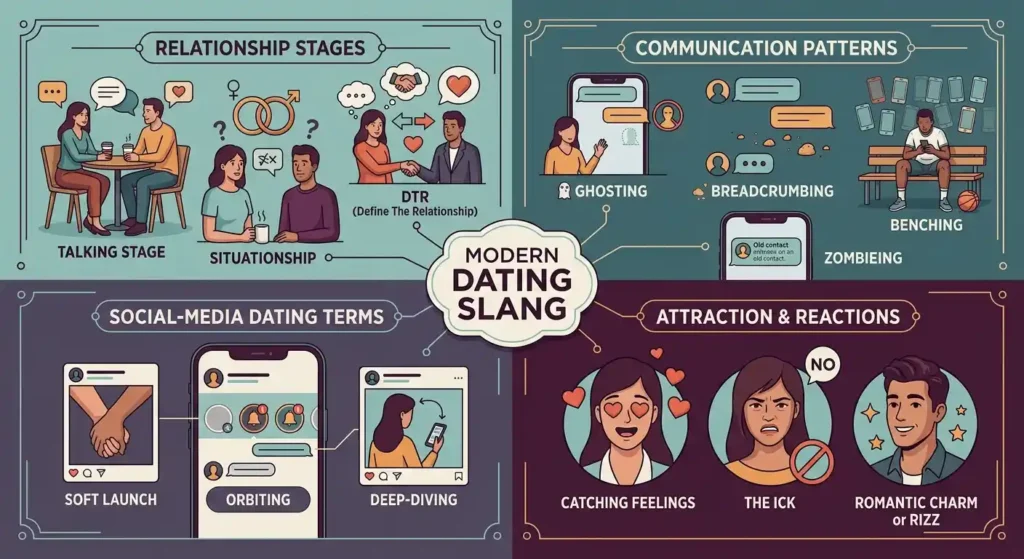
Relationship Stages
- Talking stage — getting to know someone before defining the relationship.
- Situationship — an undefined romantic or sexual connection.
- DTR — a conversation about defining the relationship.
- Cuffing season — a period associated with seeking a relationship during colder months.
Communication Patterns
- Ghosting — abruptly stopping communication without explanation.
- Breadcrumbing — maintaining someone’s interest through occasional attention without moving the connection forward.
- Zombieing — returning after previously disappearing.
- Slow fade — gradually reducing communication rather than ending things directly.
Social-Media Dating Terms
- Soft launch — subtly revealing a relationship online.
- Orbiting — remaining connected to someone’s social-media activity after direct communication has stopped.
- Pocketing/Stashing — keeping a dating partner separate from one’s wider social life.
Attraction and Reactions
- Catch feelings — begin developing romantic feelings.
- The ick — a sudden negative reaction or loss of attraction triggered by something about a person or situation.
- Rizz — slang associated with charm or the ability to attract someone.
Common Mistakes About Dating Slang
Treating Every Label as a Fact
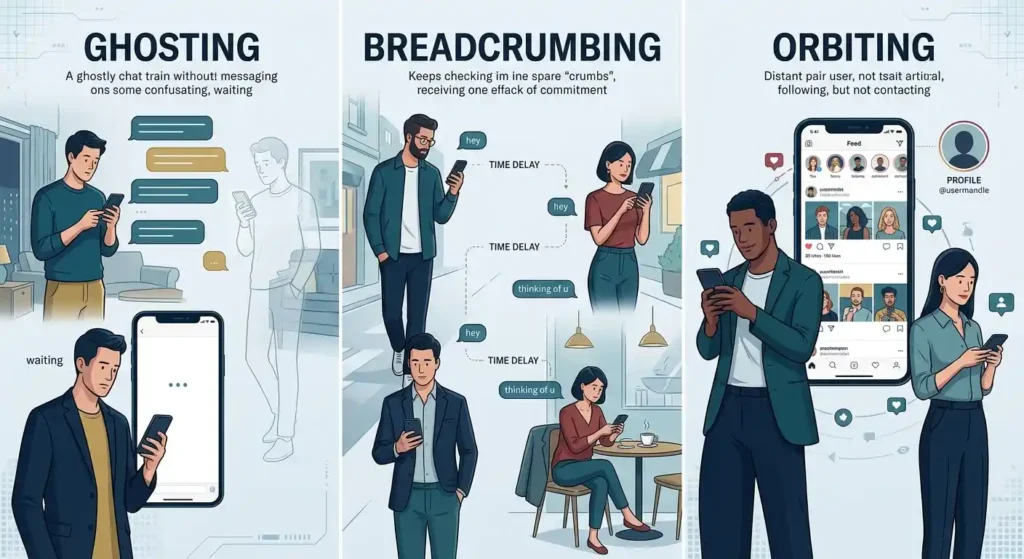
A term can describe a pattern without proving why someone behaved that way. For example, calling something “ghosting” describes the communication pattern, but it does not establish the person’s reason for disappearing.
Assuming One Meaning Fits Every Situation
Dating slang can evolve, and people may use terms somewhat differently across communities.
Assuming Slang Reveals Someone’s Feelings
A dating term cannot, by itself, prove that someone is in love, flirting, jealous, rejecting someone, or secretly interested.
Confusing Related Terms
Ghosting and orbiting are not the same: ghosting involves stopping communication, while orbiting adds continued social-media attention. Breadcrumbing is different again because it involves intermittent attention that keeps someone engaged without the connection progressing.
Dating Slang and Related Terms
| Term | Meaning | Common Use |
|---|---|---|
| Ghosting | Suddenly stopping communication | Describing disappearing after contact |
| Breadcrumbing | Giving intermittent attention without progressing | Describing mixed or inconsistent attention |
| Situationship | Undefined romantic or sexual connection | Describing an unclear relationship |
| Talking stage | Early period of getting to know someone | Describing pre-relationship dating |
| DTR | Define the relationship | Discussing relationship status |
| Soft launch | Subtle relationship reveal online | Social-media posts |
| Orbiting | Staying active around someone’s social media after direct contact stops | Social-media behavior |
| Zombieing | Reappearing after previously disappearing | Renewed contact |
| Benching | Keeping someone as an option without committing | Casual dating behavior |
| The ick | Sudden negative reaction or loss of attraction | Describing attraction changes |
These terms overlap in topic but describe different patterns or stages.
People Also Ask About Dating Slang
What is the most common dating slang?
There is no single term that represents all dating slang. Terms such as ghosting, breadcrumbing, situationship, talking stage, and soft launch are prominent examples in current dating vocabulary.
What does “situationship” mean?
A situationship generally describes a romantic or sexual connection that has not been clearly defined as a relationship. The people involved may have intimacy or regular contact without an agreed relationship label or expectations.
What does “ghosting” mean in dating?
Ghosting means suddenly stopping communication without explaining the decision. The term can also be used outside dating, but it is widely associated with dating and online communication.
What is the difference between ghosting and breadcrumbing?
Ghosting involves abruptly stopping communication. Breadcrumbing involves occasional attention or messages that keep someone engaged without the connection moving forward.
What does “DTR” mean?
DTR stands for “define the relationship.” It refers to a conversation about what a relationship is, where it is going, or what each person expects.
What does “soft launch” mean in dating?
A soft launch is a subtle social-media reveal of a relationship without fully identifying or prominently showing the partner. A post might hint at a relationship without making a formal announcement.
What does “the ick” mean?
“The ick” describes a sudden negative reaction or loss of attraction toward someone, sometimes triggered by a relatively small behavior or trait.
Why is dating slang difficult to understand?
Dating slang changes as online communities create and reuse new expressions. A term can also have slightly different meanings depending on the context, so understanding the actual behavior or conversation is more reliable than relying on a label alone.
Conclusion
Dating slang is informal vocabulary used to describe dating experiences, relationship stages, attraction, communication patterns, and social-media behavior. Terms such as ghosting, breadcrumbing, situationship, talking stage, DTR, and soft launch cover different parts of modern dating language.
The terms are mainly casual and context-dependent. Understanding the definition is useful, but a slang label alone does not establish someone’s motives or feelings. The surrounding conversation and actual behavior provide the necessary context.

For three and a half years, Charlotte Reed has worked as a writer shaping puns and jokes around distinct subjects and vocabulary. She covers food, animals, seasonal themes, technology, entertainment, and trending topics. Her process includes examining topic-specific language, building wordplay from relevant terms, and editing punchlines for sharper phrasing, structure, and comedic timing.